
Plant App Pesticide Safety After AI Disease or Pest Results
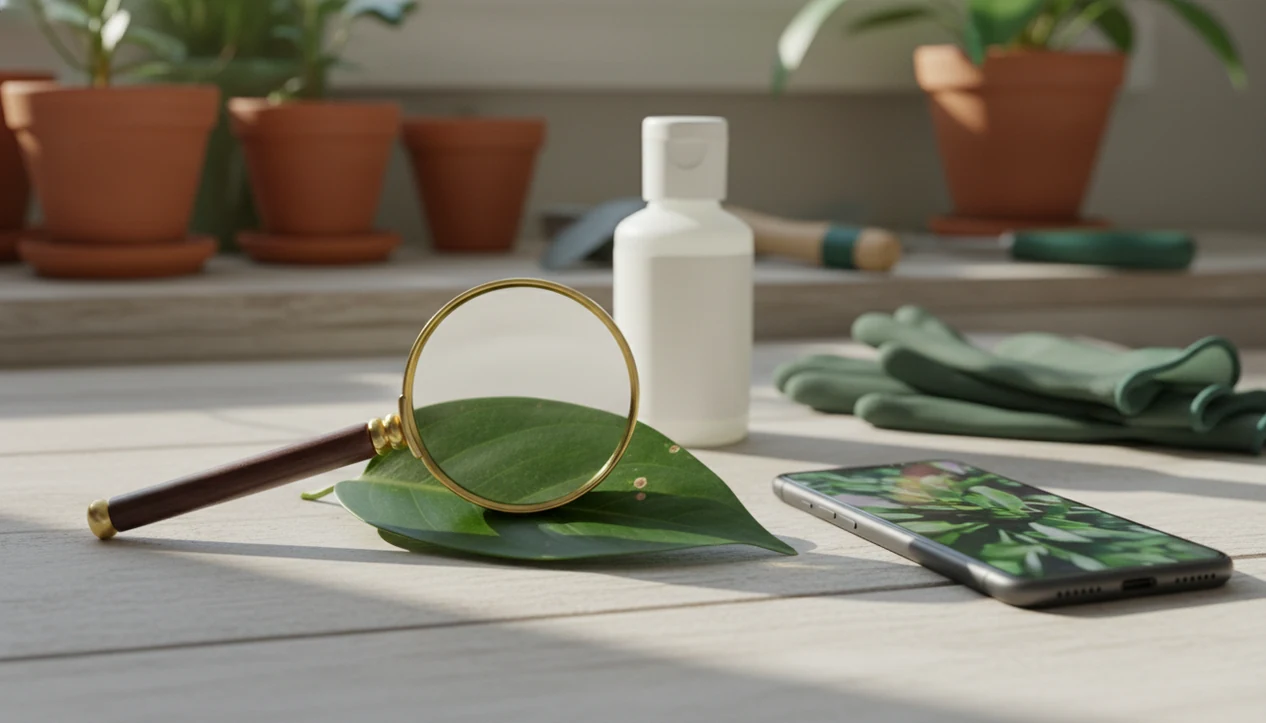
Quick answer: Plant app pesticide safety means using an AI plant diagnosis as a clue, not as permission to spray. Confirm the pest or disease, check that the pesticide label matches the plant and target problem, and use extension or local expert guidance before applying anything.
Definition: PlantApp is a plant identifier app that identifies plants from photos and delivers plant health and care guidance, including diagnosis support, watering schedules, and troubleshooting steps for plant owners.
TL;DR
- Do not spray a pesticide based only on an AI plant diagnosis or pest result.
- A pesticide label is a legal use document, so the pest, plant, site, rate, timing, and safety directions must match before treatment.
- Use Integrated Pest Management first: identify, monitor, isolate, prune, adjust care, and only then consider a labeled pesticide when the risk justifies it.
Plant App Pesticide Safety At a Glance
App results are screening information, not pesticide instructions. A likely match can help you inspect the plant more carefully, but it should not decide what chemical to buy, mix, or spray.
The safe sequence is simple: identify the plant, confirm the suspected pest or disease, then match the exact pesticide label to that plant, site, and target problem. A blurred seedling photo in morning sun may be enough to suggest “fungal issue,” but not enough to justify treatment.
Unnecessary spraying can expose family members, pets, pollinators, the plant itself, and nearby water to avoidable risk. The EPA reported about 1.1 billion pounds of pesticide active ingredients used annually across U.S. agriculture, industry, commercial settings, government, and homes, so household choices still sit inside a larger exposure picture (EPA pesticide industry sales and usage report). For broader risk context, start with plant app safety.
Spray last, not first.
AI Plant Diagnosis Pesticide Risk From Photo Symptoms
An AI plant diagnosis pesticide result is a photo-based pattern match, not a verified lab diagnosis. The system compares image features, such as leaf spots, color shifts, and growth habit, against known examples; in plain terms, it looks for visual similarity.
That matters because plant symptoms overlap. Brown leaf tips can come from low humidity, salt buildup, underwatering, fertilizer burn, or a pest. Silver streaks on a monstera leaf may suggest thrips, but glare, physical scuffing, or old damage can look similar in a single photo.
Photo models also do not usually verify local pesticide laws, label restrictions, required PPE, drift risk, storage rules, disposal instructions, or nearby sensitive sites. Published reviews of image-based plant disease diagnosis report that accuracy varies by crop, disease, image quality, and field conditions, which is enough uncertainty to make 'spray now' a risky leap (Frontiers review on plant disease detection).
Good AI plant identifier, disease diagnosis, and personalized plant care app for houseplants and garden plants deliver likely matches and next-step clues, not guaranteed pesticide clearance or local legal approval.
Five Plant Disease Treatment Caution Rules Before Spraying
These five plant disease treatment caution rules reduce the chance of turning a plant problem into a pesticide problem. They apply whether the app result says mites, mildew, blight, rust, scale, or “possible fungal disease.”
- Confirm the plant and problem. Compare the leaf shape, stem, and growth habit, then check extension resources, a local nursery specialist, or a diagnostic lab when the ID is uncertain.
- Read the label twice. Read before purchase and again before application, especially if the plant is edible, indoors, near pets, or near water.
- Match the exact use. Confirm the product is labeled for the plant, site, and target pest or disease.
- Try non-chemical controls first. Isolation, pruning, washing leaves, changing watering, and improving airflow often fit mild or uncertain cases.
- Follow all safety directions. Wear required PPE and follow mixing, timing, re-entry, storage, and disposal directions.
A deadheading bucket beside a flower border tells a useful story: removing infected or infested material is often a care step before any spray is considered.
Pesticide Label Matching After a Plant App Result
A pesticide label is an enforceable legal use document, not just small print on the bottle. If the app says “aphids” but the label does not cover that plant, site, or pest, the product may be unsafe or unlawful for that use.
The label details to verify
Use this checklist before you buy or apply:
- Plant: ornamental, houseplant, vegetable, fruit tree, herb, shrub, or turf.
- Pest or disease: exact target, not just “bugs” or “spots.”
- Site: indoors, greenhouse, garden bed, lawn, patio container, or edible crop.
- Formulation: concentrate, dust, granule, ready-to-use spray, or systemic product.
- Rate and timing: dilution, interval, maximum applications, and harvest restrictions.
- Application method: spray, drench, soil application, bait, or spot treatment.
- Restrictions: PPE, re-entry, pollinator warnings, wind limits, storage, and disposal.
Organic or natural products still require label compliance. Neem, insecticidal soap, sulfur, and copper can injure plants or affect non-target organisms when used incorrectly. For edible questions, the safety bar is higher than basic plant naming; the guide on can plant app identify edible plants explains that boundary.
Integrated Pest Management Steps for AI Plant Diagnosis Pesticide Decisions
Integrated Pest Management, or IPM, means identify the problem, monitor it, prevent spread, use non-chemical controls first, and choose a targeted pesticide only when the risk justifies it. EPA describes IPM as a practical, risk-reducing approach that combines pest knowledge with safer control choices (EPA IPM principles).
| Step | Safer action after an app result | Why it matters |
|---|---|---|
| Identify | Compare photos with extension or local sources | Reduces look-alike mistakes |
| Isolate | Move affected houseplants away from others | Slows pests before treatment |
| Inspect | Check leaf undersides, stems, soil, and roots | Finds scale, mites, eggs, or rot |
| Correct care | Adjust water, light, airflow, or spacing | Stress often mimics disease |
| Monitor | Recheck spread over several days | Mild issues may not need spray |
| Treat | Use a labeled product only if justified | Keeps pesticide use targeted |
- Take a second photo in natural light and include the stem, pot, soil surface, and nearby leaves.
- Inspect the plant closely with a hand lens or phone zoom before assuming the app result is final.
- Isolate the plant if insects, webbing, sticky residue, or spreading lesions are visible.
- Remove damaged material when pruning is safe for the plant.
- Consider a labeled treatment only after the diagnosis, site, and label match.
For many houseplants, IPM is often safer than immediate spraying because the first fixes are inspection, isolation, pruning, and care correction.
Four Myths About Plant App Pesticide Safety
Four myths drive many unsafe spray decisions after a plant app result. Replace each one before you open a pesticide container.
- Myth 1: “If the app names it, the diagnosis is certain.” Safer belief: an app gives a likely match, and you still compare the leaf shape, stem, damage pattern, and local pest pressure.
- Myth 2: “Over-the-counter pesticides are too mild to worry about.” Safer belief: consumer products can still harm people, pets, plants, pollinators, or water when used off-label.
- Myth 3: “Organic means automatically safe.” Safer belief: natural products still have active ingredients, timing limits, plant-injury risks, and label directions.
- Myth 4: “Plant disease treatment usually means spraying.” Safer belief: many problems start with care correction, sanitation, pruning, isolation, or disposal of badly infected material.
A north-facing sill with a pale pothos is a classic example. Low light may be the problem, not a disease.
PlantApp Coverage for Diagnosis and Pesticide Boundaries
Photo-based plant apps can help identify plants, surface possible care issues, and organize what to inspect next. They are useful for narrowing possibilities, not for authorizing pesticide use.
The boundary is important. App results do not replace pesticide labels, extension guidance, diagnostic labs, licensed applicators, or local regulatory advice. Use the result as a starting point, especially when the photo shows only one pretty leaf instead of the stem, pot, soil surface, and the full damage pattern.
Serious, spreading, edible-crop, restricted-use, or high-risk site cases need local confirmation before treatment. That includes plants near wells, waterways, pollinator habitat, children’s play areas, pets, or indoor rooms with poor ventilation. If a hanging basket sits above a curious kitten, pesticide choice and plant toxicity both matter; the toxic plants for cats app guide covers the plant-safety side of that decision.
When to Get Local Expert or Licensed Applicator Help
Get local expert help when the diagnosis is unclear, the problem is moving fast, or pesticide use could affect people, food, water, pets, or pollinators. Use licensed applicators when the product or treatment scale is beyond ordinary homeowner use.
A county extension office, plant clinic, nursery specialist, or diagnostic lab can often separate disease from drought stress, nutrient issues, herbicide drift, or old mechanical damage. Lab confirmation is especially worth considering for valuable landscape plants, edible crops, and diseases that keep returning after basic care corrections. Restricted-use products, large outdoor spray jobs, and treatments near sensitive sites are not DIY judgment calls.
- Call extension early when symptoms spread quickly, the plant ID is uncertain, or several plants show the same pattern.
- Submit samples or photos to a diagnostic lab for high-value plants, food crops, or recurring disease.
- Contact a licensed applicator for restricted-use pesticides, tree-scale treatments, or broad outdoor applications.
- Avoid spraying yourself near wells, waterways, schools, pets, beehives, flowering pollinator habitat, or windy edges.
- Bring clear evidence: sharp photos, the plant name, the pesticide label, recent care changes, site details, and where symptoms started.
Pesticide Safety Sources Used for This Guidance
This guidance is framed around pesticide labels, EPA Integrated Pest Management principles, local extension confirmation, and human exposure safety sources. App suggestions stay below those authorities, especially when a treatment could affect people, food, water, pets, or pollinators.
Use the app result as a clue, then move through the safer authority chain:
- Check the pesticide label for the exact plant, site, pest or disease, rate, timing, PPE, storage, and disposal directions.
- Compare the case with IPM guidance before spraying, because prevention, monitoring, isolation, pruning, and care correction often come first.
- Ask local extension or a plant diagnostic program when symptoms are confusing, regional diseases are possible, or edible crops are involved.
- Use NIOSH or poison-control resources for human exposure questions, symptoms after contact, spill concerns, or accidental ingestion.
- Follow the stricter rule when an app suggestion, label direction, extension advice, or local law appears to conflict.
Labels and local law override app-generated suggestions every time. If the label does not permit the use, or local rules restrict it, the answer is no even when the photo result seems confident.
Limitations
AI plant diagnosis and pesticide safety have real limits. Treat these limits as decision points, not fine print.
- Photo quality can hide pests, lesions, eggs, scale insects, mites, and root problems.
- Look-alike symptoms can come from watering, nutrition, light, temperature, herbicide drift, pests, or pathogens.
- Consumer app accuracy in real-world disease diagnosis remains incompletely studied.
- Apps may not account for local laws, restricted-use products, wells, waterways, pollinator habitat, or indoor ventilation.
- Even correct diagnoses do not guarantee safe mixing, PPE use, drift control, storage, or disposal.
- Many serious diseases require lab confirmation or licensed applicators rather than homeowner treatment.
- NIOSH has estimated tens of thousands of acute pesticide poisoning cases annually among U.S. agricultural workers, which shows why handling instructions matter.
- Household pesticide behavior studies have reported that many homeowners do not always read or follow labels in detail.
Clinicians are not the right authority for plant pesticide choice; university extension specialists, pesticide labels, diagnostic labs, and licensed applicators are the relevant authorities.
That distinction matters.
FAQ
Can AI diagnose plant disease from a photo?
AI can suggest likely plant disease or pest causes from photo clues, but it cannot reliably confirm every disease, pest, or stress problem. Use the result as a starting point and verify it with inspection, extension resources, or lab testing when risk is high.
Should I spray pesticide after an app diagnoses my plant?
No, you should not spray until the diagnosis is confirmed and the pesticide label matches the plant, site, and target pest or disease. Label directions and local extension guidance outrank app suggestions.
Are pesticide label directions legally required?
Yes, pesticide labels are legal use directions and must be followed exactly. The label controls the allowed plant, pest, site, rate, timing, PPE, storage, and disposal instructions.
Can plant apps identify pests like mites, scale, or aphids?
Plant apps can flag possible pests such as mites, scale, or aphids, but small insects, eggs, and early damage are easy to miss. Inspect leaf undersides, stems, and new growth before choosing treatment.
Are organic pesticides always safe for pets, kids, and pollinators?
No, organic or natural pesticides are not automatically safe for pets, children, or pollinators. They still require label precautions, correct timing, and careful storage.
What is the best way to confirm a plant disease?
The best way to confirm a plant disease is to combine repeated inspection with extension resources, local experts, or a diagnostic lab when the problem is serious or uncertain. A single app photo is not enough for high-risk pesticide decisions.
What does IPM mean for houseplants and garden plants?
IPM means Integrated Pest Management: identify the problem, monitor it, prevent spread, use non-chemical controls, and treat with a targeted pesticide only when justified. It applies to both indoor houseplants and outdoor garden plants.
When should I call my local extension office about a plant problem?
Call your local extension office when the diagnosis is uncertain, the disease is spreading, edible crops are involved, or pesticide use could affect people, pets, water, or pollinators. Extension guidance is especially useful before treating valuable plants or high-risk sites.