
Check Plant Name From Photo And Confirm Lookalikes First
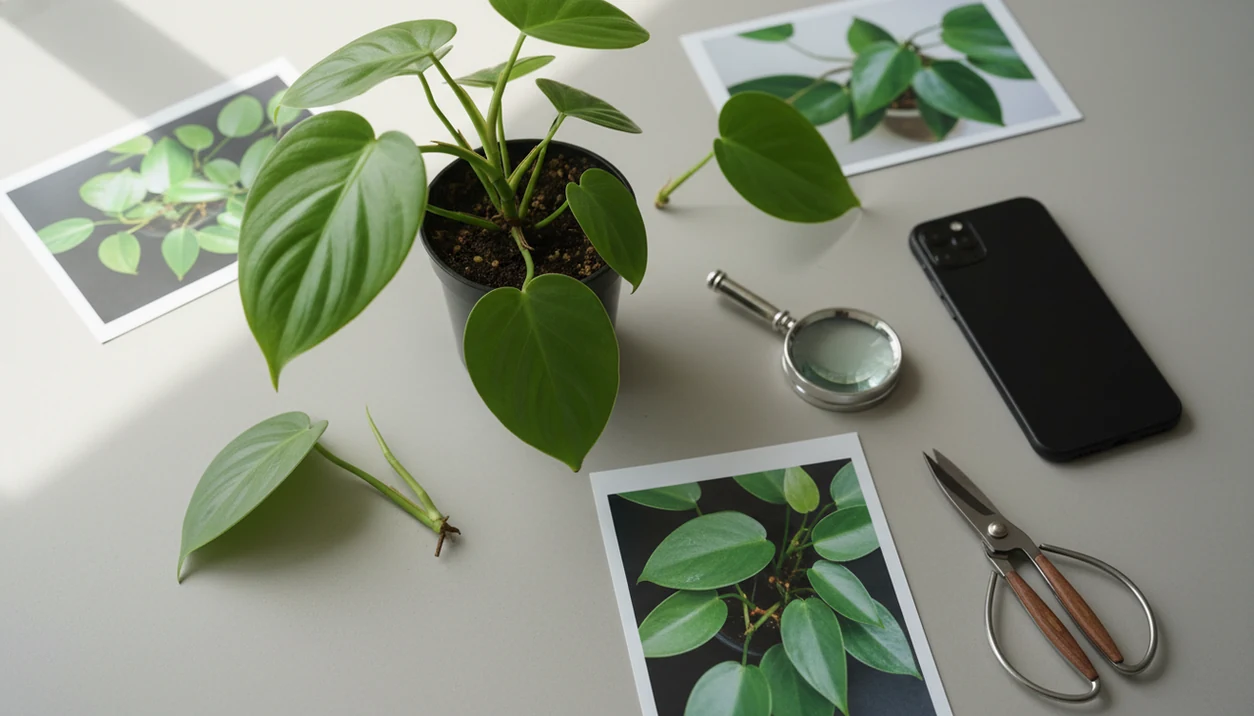
Use photo plant identification to check a plant name from a photo, then confirm the result with better photos and a lookalike check before watering, pruning, pulling, or making safety decisions. A photo match is a likely identification, not a guarantee, especially when toxicity, pets, children, weeds, or plant disease treatment are involved.
> Photo plant identification compares plant photos with image datasets to suggest a likely plant name, then may provide care, watering, and disease troubleshooting guidance for plant owners.
- Photo plant identification gives a probable plant name, not a certain one.
- The best confirmation photos show the whole plant, leaf, stem, flower or fruit, and growing context.
- For toxicity, ingestion, invasive plants, or chemical treatment, cross-check the plant name with more than one source.
At-a-glance plant name checker rules before you act
A plant name checker returns a probable match, not proof. Use the result for low-stakes care only when several clues agree, such as leaf shape, stem type, growth habit, potting mix, and where the plant is growing.
Routine care is different from risk. It is usually reasonable to adjust a watering category after the app, the plant shape, and the soil surface all point to the same broad group. A finger pressed into dry potting mix can confirm the care problem better than the name alone.
Pause first.
Do not rely on one photo before judging toxicity, pulling a weed, pruning hard, or treating disease with chemicals. Lookalikes are the main failure point. A glossy heart-shaped leaf may suggest several houseplants, and a seedling in a bed may not show its adult features yet.
How photo plant name checker tools work
A photo plant name checker works by comparing visual features in your image with large plant photo datasets, then ranking likely matches. The model creates image embeddings, which are numeric patterns that help it compare leaf edges, flower shape, stem texture, and overall growth habit.
When available, tools may also weigh background clues, season, and location. A humid bathroom shelf after showering tells a different story than a dry roadside verge in August. Genus-level matches, such as “Philodendron,” can be useful for broad care. Species-level matches are narrower, but harder.
Certainty is difficult because global plant diversity is huge. World Flora Online and related plant lists indicate more than 390,000 known vascular plant species worldwide (World Flora Online: https://wfoplantlist.org/). For beginners, an identify plant from photo workflow usually works best when the photo set shows the plant from more than one angle.
7 steps to use a plant name checker with better photos
To find plant name from photo more reliably, submit a small photo set instead of one attractive leaf. Blurry leaf photos taken under yellow kitchen light at 10 p.m. are common, but they make lookalikes harder to separate.
- Photograph the whole plant so the tool can read height, spread, and growth habit.
- Capture a leaf close-up with the edge, veins, and surface in focus.
- Show the stem and nodes because climbing, trailing, woody, and rosette plants differ there.
- Add flowers, fruit, bark, or thorns if present, since reproductive parts often narrow the name.
- Use natural light and avoid blur, harsh shadows, indoor color casts, and cluttered backgrounds.
- Submit more than one image when the app allows it, especially for weeds and wild plants.
- Review confidence and alternate matches before changing care, removing plants, or checking safety.
Photo evidence that improves plant name accuracy
A single leaf is often weaker than a photo set because many unrelated plants share similar leaf shapes. The strongest evidence combines plant parts, context, and season.
- Leaf arrangement matters: Opposite, alternate, whorled, and basal leaves can separate close matches.
- Veins, stems, and nodes matter: These clues often distinguish pothos-type foliage from philodendron-type foliage.
- Flowers, fruit, bark, and thorns matter: If present, they can move a result from genus-level to species-level.
- Growth habit matters: A vine, shrub, grass clump, rosette, or tree seedling points the model in different directions.
- Context matters: Indoor houseplants, outdoor weeds, wild plants, location, and season all narrow lookalikes.
For trees, bark and buds can be just as useful as leaves; a separate identify tree by leaf check helps when the canopy photo is too vague.
4-part method for confirming a plant name from photo
How do you confirm a plant name from a photo? Use the first app result as a starting point, take a second photo set, compare alternate matches, then verify care or toxicity claims against another source.
Start with the likely match, but do not stop there. Photograph the whole plant, stem, leaf underside, flower or fruit, and growing location. Then compare the top two or three names. A 2022 study of image-recognition plant ID apps found that the most accurate app reached species-level identification about 88% of the time under test conditions, while other apps performed worse. (study source: https://doi.org/10.1371/journal.pone.0264789)
That means “high confidence” is not the same as “settled.” For routine care, enough confirmation may mean the same genus and care category appear across tools. For safety, removal, invasive status, or chemical treatment, cross-check with another app, a botanical database, an extension service, or a local expert. Good AI plant identifier, disease diagnosis, and personalized plant care app for houseplants and garden plants deliver likely matches and next steps, not guaranteed species confirmation from one image.
3 real-world outcomes after using a plant name checker
These outcomes show what a plant name checker can change today. The useful result is often not a perfect label; it is a safer next step.
Maya checks a houseplant care match
Maya gets a likely philodendron-type result, then checks the climbing habit and nodes before changing care. She waters less after noticing the soil line shrinking from the pot edge, not just because the app named a tropical plant.
Jon checks a garden weed lookalike
Jon scans a seedling in an overgrown corner of a raised bed, then pauses before pulling it. The alternate matches look too close, so he checks local context and waits for more leaves.
Priya checks a pet safety concern
Priya sees a possible toxic plant result after finding paw prints in damp potting soil. She moves the plant high, verifies the name, and treats the result as a warning rather than permission. Tools like PlantApp can help organize likely names, care notes, and toxicity cautions, but safety calls still need verification.
Common plant lookalike patterns in photo identification
Lookalikes are most common when plants lack flowers, fruit, mature leaves, or clear growth context. Cultivar and variety differences can also affect care even when the genus is right, and toxicity may differ between plants that look similar.
| App result pattern | Evidence needed | Safer action |
|---|---|---|
| Similar succulents | Rosette shape, leaf thickness, offsets, bloom stalk | Confirm before watering changes or pet access |
| Philodendron or pothos-type foliage | Nodes, petiole shape, climbing habit, leaf texture | Use broad care only until species is clearer |
| Grasses and grasslike weeds | Seed heads, sheath, ligule, growth site | Verify locally before pulling or treating |
| Seedlings and immature plants | More true leaves, spacing, bed history | Wait and rescan rather than act early |
| Damaged or dormant plants | Healthy part, bark, buds, season | Avoid disease or pruning decisions from one image |
If the issue is spotting pests or disease rather than naming the plant, a plant disease diagnosis app can be a care step, not a cure.
Limitations
Photo-based plant identification is useful, but it has hard limits. Treat the result as evidence, not a final ruling.
- Photo identification is probabilistic and can be wrong, especially from one leaf or a blurred image.
- Apps vary in accuracy and may favor common, well-photographed species over rare regional plants.
- Young, dormant, damaged, non-flowering, or recently pruned plants are harder to identify.
- Disease diagnosis from a single photo can confuse fungal, bacterial, nutrient, pest, and mechanical damage.
- Genus-only results may be fine for broad watering, but not for toxicity or species-specific care.
- Similar-looking plants can have different toxicity risks for pets, children, livestock, or people.
- No app replaces poison control, a veterinarian, an extension office, or a qualified local expert in high-stakes cases.
NIOSH notes that more than 700 plant species in the United States are considered poisonous to humans (NIOSH: https://www.cdc.gov/niosh/topics/plants/default.html). That is enough reason to verify before assuming a plant is safe.
FAQ
Can I identify plants by photo?
Yes, many plants can be identified from photos, but the result should be treated as a likely match. Confirm before toxicity, ingestion, pruning, pulling, or chemical treatment decisions.
Is there an app that can identify a plant from a photo?
Yes, photo plant name tools can check a plant name from a phone photo and often provide care guidance. PlantApp is one option, alongside tools such as Pl@ntNet, PictureThis, and Google Lens.
Are photo plant name checkers accurate?
Accuracy varies by tool, photo quality, species, growth stage, and whether flowers or fruit are visible. Apps are usually more reliable for distinctive, common plants than for rare or immature lookalikes.
What photos help identify a plant most accurately?
Use a whole-plant photo, leaf close-up, stem or node photo, flower or fruit photo, and growing-context shot. Natural light and a clean background help more than a single pretty leaf.
Can Google Lens name plants?
Google Lens can suggest plant names from photos, but it should be cross-checked for lookalikes. Do not use one Lens result alone for safety or removal decisions.
Can a photo show whether a plant is toxic?
A photo may suggest a plant identity linked to toxicity, but it cannot prove safety. Verify the plant name with reliable sources before allowing pet, child, or human access.
Why did two plant identifier apps disagree?
Different apps use different datasets, models, confidence thresholds, and specialty strengths. A disagreement means you should collect better photos and compare the alternate matches.
Should I trust a genus-only plant ID?
A genus-only ID can be useful for broad care, such as succulent versus tropical foliage watering. Species-level confirmation matters for toxicity, invasive status, pruning, and treatment decisions.