
Identify Tree By Leaf Photos, Bark, Buds, And Location
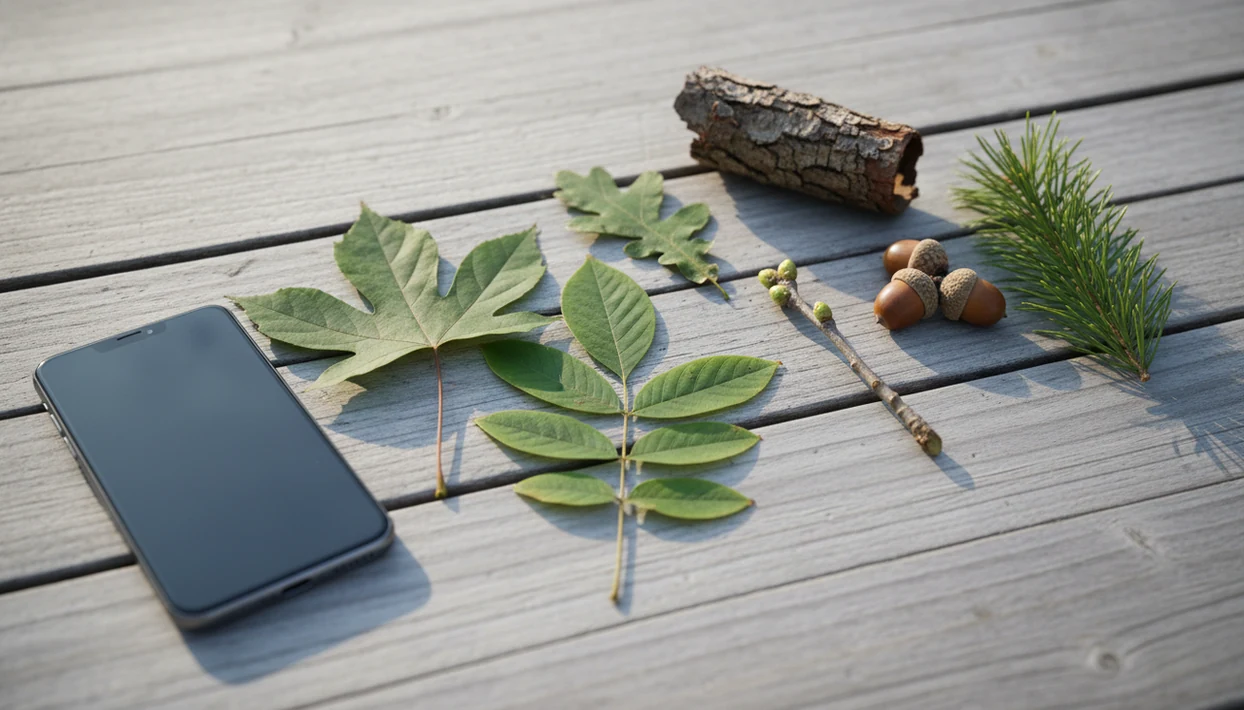
To identify tree by leaf, start with a clear photo of several healthy leaves, then confirm the match with leaf arrangement, bark, buds, fruit, and your location. A phone-based tree leaf identifier can quickly suggest likely names, but the safest ID comes from checking more than one feature.
> Definition: Tree identification by leaf is the process of using leaf type, shape, margin, veins, arrangement, and seasonal context to narrow a tree to a likely genus or species.
TL;DR
- Use several leaves, not one damaged or unusually shaped leaf.
- Confirm any app result with bark, buds, fruit, branching pattern, and location.
- Treat phone-based tree ID as a probable match when health, legal, or toxic plant risks are involved.
Tree Identification By Leaf: The 5 Facts To Check First
- Leaves are the starting clue, not the whole ID. A leaf can quickly narrow a tree, but bark, buds, fruit, and habitat often decide the final match.
- First split broadleaf trees from conifers. Broad flat leaves point you toward one group; needles or scale-like foliage point toward pines, spruces, firs, cedars, and relatives.
- Check leaf structure before shape. Decide whether the leaf is simple or compound, then compare size, outline, margin, lobes, and vein pattern.
- Leaf arrangement matters. Alternate, opposite, or whorled leaves on the twig can separate look-alikes before you get lost in small edge details.
- App results are probable matches. A tree leaf identifier reads photo clues fast, but a blurred leaf under shade can still push it toward the wrong species.
For beginners, the easiest win is boring: photograph three ordinary mature leaves. Not the prettiest one. Not the chewed one.
Tree Leaf Identifier Phone Photos: How Image Matching Works
A tree leaf identifier works by comparing visible photo patterns, such as leaf shape, edge, veins, color, and texture, against examples the model has learned from prior images.
Behind the screen, image recognition converts the photo into image embeddings, which are numerical patterns that group similar-looking leaves near each other. In plain terms, the app is asking, “What known tree photos look most like this?” Multiple photos improve the answer because bark, fruit, buds, and whole-tree form add separate signals. A sidewalk weed framed in camera can be easy; a tall street tree with half-hidden leaves is harder.
Photo-identification tools are best used as shortlist generators: compare the suggested genus or species against the visible leaf, twig, bark, fruit, and range clues before you act. A strong result should still make sense for the tree’s location, season, and habitat.
Tree Leaf Photo And Location Checklist Before You Start
Before you open a guide or app, collect better evidence: clear leaf photos, twig context, bark, reproductive parts, and location details. Better input usually means a better likely match.
Take photos in natural light with the leaf flat and in focus. Photograph the top and underside, then include the twig attachment so you can see whether leaves are alternate, opposite, or whorled. Add bark, buds, fruit, flowers, seed pods, cones, and the whole tree form if you can reach a safe angle. A winter shadow across an apartment floor is fine for houseplants, but outdoor tree leaves need daylight, not yellow porch light.
Record city or region, habitat, season, and whether the tree seems planted or wild. Disease spots, insect feeding, drought curl, and fall color can distort the clues that guides and apps use. For broader leaf comparisons beyond trees, the identify plant by leaf guide uses the same habit of checking several leaves.
Tree Leaf Identifier App Workflow: 5 Phone Steps
Use this phone workflow when you want a practical tree identification by leaf, not just a quick guess from one pretty leaf.
- Open your tree leaf identifier and choose a sharp photo of several healthy leaves in natural light.
- Add close-up photos of bark, buds, fruit, cones, flowers, and branching if they are visible.
- Review the top matches and compare leaf shape, margin, veins, arrangement, and growth habit.
- Use location and season to remove trees that do not grow in your region or would not show that feature now.
- Save the result with notes if the tree is on your property, including care concerns, brown leaf tips, pests, or disease clues.
The saved note is useful later. Tree IDs often get easier after buds swell, fruit forms, or bark texture becomes clearer in better light. If the scan also shows cankers, spots, or dieback, a plant disease diagnosis app workflow can help separate identification from health troubleshooting.
Step 1: Identify Broadleaf Trees, Needles, And Scales
“Is this a broadleaf tree or a conifer?” is the first question because it sends you to the right part of a guide.
Broadleaf trees usually have flat leaves with a visible blade, like maple, oak, birch, elm, or magnolia. Conifers often have needles or scale-like foliage, as seen on pines, spruces, firs, junipers, and cedars. Needles may grow singly, in bundles, or along a twig. Scales can look like overlapping green plates rather than separate leaves.
Do not use evergreen as a shortcut. Some broadleaf trees stay green through winter, and some conifers lose their needles. Also, deciduous does not always mean broadleaf.
This first split prevents wasted searching. If the photo shows bundles of long needles, a broadleaf chart will only add confusion.
Step 2: Use Leaf Shape, Margin, Lobes, And Veins
After the broadleaf-or-conifer split, compare structure before chasing the exact tree name. Simple versus compound leaves is the mistake that trips up many phone searches.
A simple leaf has one blade attached to the twig. A compound leaf has several leaflets attached to one leaf stalk. Beginners often photograph one leaflet and treat it as a full leaf, which can make ash, walnut, locust, and hickory results drift badly.
| Leaf clue | What to look for | Why it matters |
|---|---|---|
| Simple or compound | One blade, or many leaflets on one stalk | Prevents confusing a leaflet with a full leaf |
| Margin | Smooth, toothed, serrated, wavy, or lobed | Separates many common genera |
| Shape | Oval, heart-shaped, lance-shaped, fan-shaped, or star-shaped | Gives a fast visual shortlist |
| Veins | Parallel, branching, palmate, or pinnate | Helps confirm the pattern |
| Size | Measure several mature leaves | Young or shaded leaves can mislead |
Compare several mature healthy leaves from the same tree. One strange leaf happens.
Step 3: Confirm Tree Identification By Leaf Arrangement And Buds
Leaf arrangement is one of the fastest ways to confirm or reject a tree identification by leaf. Look at the twig, not just the blade.
Alternate leaves attach one at a time along the twig. Opposite leaves appear in pairs across from each other. Whorled leaves form three or more leaves at the same node. Many maples have opposite leaves, while many oaks have alternate leaves, but treat those as helpful patterns rather than absolute rules. Young shoots and damaged twigs can behave oddly.
Buds are excellent confirmation clues in winter and early spring. Their size, color, shape, scales, and position can separate trees that had similar summer leaves. If the leaves are high or chewed, the branching pattern may still show whether the tree tends toward opposite or alternate growth.
A close twig photo beats a dramatic canopy shot. Every time.
Step 4: Match Bark, Fruit, Flowers, And Local Range
Leaf matches get safer when you confirm them with bark, fruit, flowers, and local range. Region and habitat remove many impossible answers before you worry about fine details.
Bark changes with age, but it still helps. Look for color, ridges, plates, peeling strips, diamond patterns, smooth patches, and small lenticels. Mature trees often show bark traits that young saplings do not. Fruits, nuts, cones, seed pods, catkins, and flowers are high-value evidence because they connect the leaf to a reproductive structure.
Tree diversity is large enough that context matters. A global analysis estimated about 3.04 trillion trees on Earth source. New York City alone recorded more than 680,000 street trees in its street tree census source.
For mature trunks, the identify plant by bark guide covers bark clues in more detail.
Common Tree Leaf Identifier Mistakes That Cause Wrong IDs
Most wrong tree IDs come from weak evidence, not from one mysterious rare species. These are the mistakes we see most often when reviewing phone photos.
- The single-leaf shortcut. One leaf can be damaged, juvenile, shaded, or from a sucker shoot that looks unlike the canopy.
- The fallen-leaf assumption. A leaf on the ground may have blown in from another tree, especially along sidewalks and parking lots.
- The leaflet mix-up. Compound leaves are easy to misread if you photograph only one leaflet.
- The season blind spot. Spring leaves, drought-stressed summer leaves, and fall color can all change shape and color clues.
- The final-answer app result. AI can suggest a likely match, but it should not be treated as proof.
- The wrong-region chart. A field key made for another state or country may include unlikely matches and miss local trees.
Use the app result as a starting point, then check against a regional source.
Tree Identification Confidence Check Before Pruning, Removal, Or Foraging
Before you prune, remove, treat, sell, protect, or eat anything from a tree, place the ID on a confidence ladder: likely genus, likely species, or confirmed species. That simple label changes what you should do next.
A likely genus may be enough for casual curiosity. A likely species may guide ordinary care on your property. Confirmed species is the level to seek for protected trees, removals, toxic look-alikes, allergy concerns, edible-use decisions, or legal disputes. Compare the app result with a regional extension guide, field guide, local arborist, forester, or botanical garden resource when stakes are high.
Use any photo-based result with caution when the ID is uncertain. For general plant-photo habits, the identify plant from photo guide follows the same evidence-first approach.
For property decisions, tree identification by leaf is often useful for a first pass because it narrows the search quickly, but expert verification is safer when removal, toxicity, or edible use is involved.
Limitations
Leaf-based tree identification is useful, but it has real limits. Treat these as stop signs before acting on a high-stakes result.
- Closely related species, hybrids, and cultivars can look nearly identical by leaf.
- Winter identification often needs buds, twigs, bark, and overall habit because leaves may be absent.
- Damaged, diseased, drought-stressed, juvenile, or fall-colored leaves can mislead both people and apps.
- Some trees produce different leaf shapes on the same plant, especially on young shoots or vigorous regrowth.
- Uncommon ornamentals, rare natives, and out-of-region trees may fall outside an app or guide’s strongest coverage.
- Fallen leaves may not belong to the tree above them.
- Phone photos can hide scale, surface texture, hairiness, and vein detail.
- No app replaces expert confirmation for legal, health, toxic plant, protected species, or edible-use decisions.
Apps such as PlantApp, Pl@ntNet, PictureThis, and regional keys are most useful when they are treated as comparison tools. Not judges.
FAQ
Can one leaf identify a tree?
One leaf can suggest a likely tree match, especially for distinctive species. It is often not enough for reliable species confirmation without bark, buds, fruit, arrangement, and location.
What leaf details matter most?
The most important leaf details are simple or compound structure, shape, margin, lobes, veins, size, and arrangement on the twig. Compare several mature healthy leaves from the same tree.
Are tree identifier apps accurate?
Tree identifier apps can be useful for likely matches, especially with multiple photos. Accuracy drops when photos are blurry, leaves are damaged, or similar species share the same leaf traits.
How do I photograph leaves?
Use natural light, focus on the leaf, include a size reference, and photograph both sides. Also capture the twig attachment so arrangement and buds are visible.
What is a compound leaf?
A compound leaf has multiple leaflets attached to one leaf stalk. The full leaf attaches to the twig at a bud, while individual leaflets usually do not.
Can bark confirm leaf ID?
Bark can confirm or reject a leaf-based match by showing texture, color, ridges, plates, peeling, or lenticels. It works best when checked with buds, fruit, and local range.
Can I identify winter trees?
Yes, but winter tree identification relies more on buds, twigs, bark, branching pattern, and any remaining fruit. Leaf-based clues are limited when deciduous trees are bare.
Is leaf ID safe for foraging?
Leaf identification alone is not safe for foraging. Get expert confirmation before eating tree leaves, fruit, nuts, bark, sap, or any other plant part.