Identify Plant By Leaf Shape, Veins, Edges, And Pattern
To identify plant by leaf, compare the leaf shape, edge, vein pattern, arrangement on the stem, texture, and growing context, then confirm the match with photos of the whole plant. A leaf photo can narrow the answer quickly, but it is rarely proof by itself because many species share similar leaves.
Definition: Plant leaf identification means using visible leaf traits, stem arrangement, and growing context to narrow an unknown plant to a likely genus or species.
TL;DR
- Use leaf shape, margins, veins, arrangement, texture, and the whole plant habit together.
- Take multiple photos: leaf top, leaf underside, stem attachment, whole plant, flowers, fruit, bark, or pot context.
- Treat any leaf identifier app result as a ranked suggestion, not a guaranteed species ID.
Plant Leaf Identification Traits That Matter Most
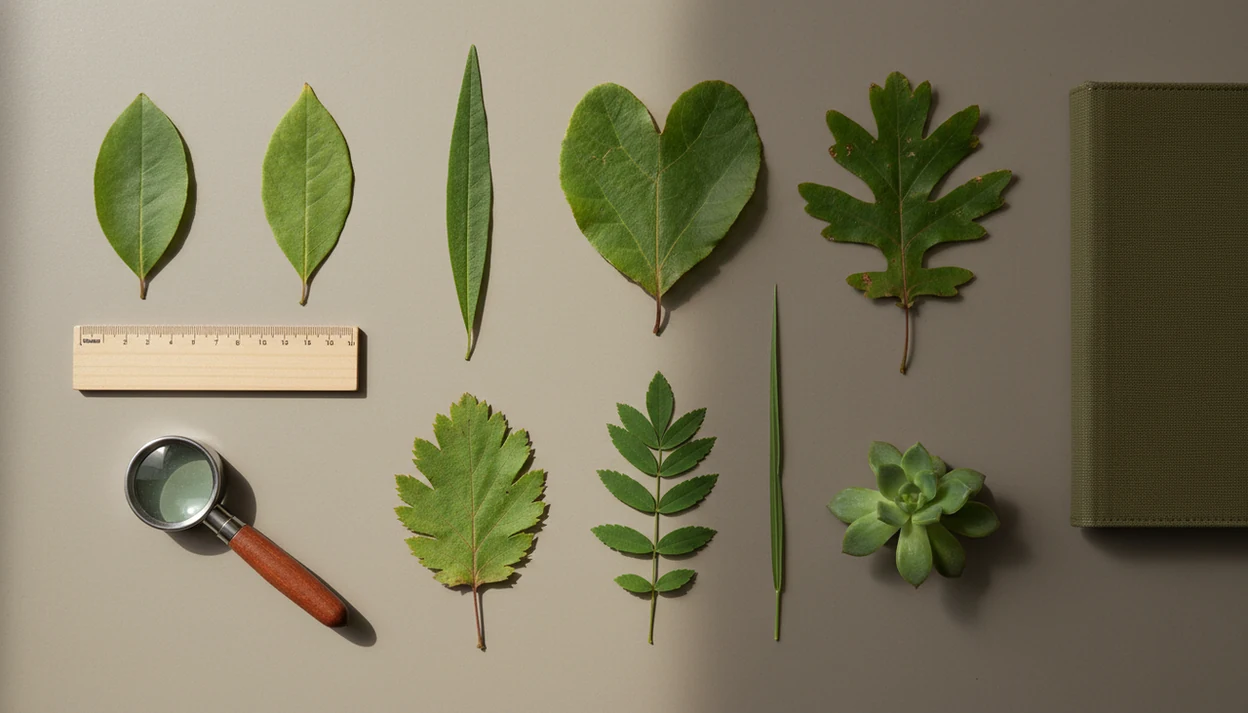
The strongest plant leaf identification starts with whether the leaf is simple or compound, then checks the edge, veins, stem arrangement, and texture. A simple leaf has one blade. A compound leaf has several leaflets attached to one leaf stalk, which is why beginners often count one leaf as many.
Margins are the next clue: smooth, toothed, serrated, lobed, wavy, or spiny. Veins can be parallel, pinnate, palmate, netted, or built around a prominent midrib. Arrangement matters too. Leaves may be alternate, opposite, whorled, or clustered in a basal rosette.
Small details help when the obvious traits overlap. Feel for hairiness, waxiness, thickness, or a rubbery succulent texture. Note leaf size and color variation. A single pretty leaf on the table tells less than a stem, soil surface, and whole plant in the same frame.
Five Facts About Identifying A Plant By Leaf
- A single leaf photo is usually a best guess, not proof, because unrelated plants can share similar leaf shapes.
- Leaf arrangement, margin, vein pattern, and growth form improve accuracy more than green color alone.
- Leaf identifier apps work better with multiple clear photos, especially leaf top, underside, stem, and whole plant.
- Region, habitat, indoor versus outdoor setting, and cultivated versus wild status narrow the candidate list quickly.
- Disease-like leaf symptoms can come from pests, pathogens, water stress, light stress, or nutrient imbalance.
For beginners, a leaf-based match is often easiest when the plant has mature, undamaged leaves and a visible growth habit. Blurry leaf photos under yellow kitchen light at 10 p.m. are still useful sometimes, but they should not be the only evidence.
How Identifying A Plant By Leaf Works
Identifying a plant by leaf works by using visible leaf traits to narrow the possible matches, not to prove the species on their own. The leaf gives clues, then the rest of the plant and its setting confirm or reject the guess.
Start by comparing shape, margin, venation, and arrangement. Venation simply means the vein pattern, such as parallel, palmate, or netted. Arrangement means how leaves attach to the stem, such as opposite, alternate, whorled, or in a basal rosette. Those traits point toward candidate plant groups and remove many poor matches before you look at finer details.
A practical check follows a simple sequence:
- Compare the leaf shape, edge, veins, texture, and attachment pattern.
- Match those traits to likely groups instead of jumping to one species name.
- Remove options that do not fit the region, season, habitat, or indoor versus outdoor setting.
- Confirm the best match with flowers, fruit, bark, stems, scent, sap, thorns, or growth habit.
- Treat app results as ranked visual similarity, not verified botanical identity.
That is why a clear leaf photo can be very useful and still not be the final answer.
Leaf Identifier App Matching With Photo Models
Leaf identifier apps work by turning a photo into visual features, comparing those features with a trained image model, and returning ranked possible matches. In AI terms, the model uses image embeddings, which means it groups visually similar photos in a mathematical space.
Published results show why context matters: a 2021 Pl@ntNet evaluation reported 79% top-1 species success on images from its own database and 61% on external test images (https://arxiv.org/abs/2106.01345), while a Flavia leaf-dataset model exceeded 93% accuracy for 32 species under controlled imaging (https://flavia.sourceforge.net/), which is not the same as a windy sidewalk weed framed in a camera.
Lighting, angle, background clutter, plant maturity, and training data all affect the result. App confidence is a model ranking, not guaranteed botanical truth. PlantApp is best used as a leaf identifier app for ranked photo matches, care guidance, watering clues, and disease troubleshooting, not as a final authority on edible, toxic, protected, or invasive plants.
Six Photo Steps For Better Leaf Identifier App Matches
Use a leaf identifier app as a structured photo workflow, not just a one-shot scanner. Good images make the model compare more than a flat patch of green.
- Photograph the whole plant before close-ups, including height, branching, and growth form.
- Capture the top and underside of several mature leaves, not just the cleanest one.
- Show the leaf attachment on the stem so alternate, opposite, whorled, or rosette patterns are visible.
- Add flowers, fruit, bark, thorns, tendrils, pot, or habitat when available.
- Review the top matches and reject options that do not fit region, growth form, or visible traits.
- Save the likely ID with notes before using care or disease advice.
That last step matters. Plant tags fade in sun or disappear with the nursery sleeve, and notes prevent the same mystery next month.
Step 1: Identify Plant By Leaf Shape And Growth Form
How do you identify plant by leaf shape first? Start with the broad plant type: tree, shrub, vine, herb, grass-like plant, succulent, or houseplant. Growth form cuts away bad matches before you worry about species names.
Next, compare the leaf shape. Common categories include oval, heart-shaped, lance-shaped, needle-like, fan-shaped, palmate, and lobed. If you are working on a woody plant, a dedicated guide to identify tree by leaf can help separate canopy shape, bark, buds, and leaf arrangement.
Young leaves can mislead you. Juvenile foliage may be softer, smaller, redder, or more deeply cut than mature leaves. Stressed, sunburned, variegated, or cultivar leaves may also fail to match standard field guide images. A crispy brown margin on one leaf is a stress clue, not the plant’s normal outline.
Step 2: Match Leaf Veins, Edges, And Stem Arrangement
Edges, veins, and arrangement are more diagnostic than green color alone. A serrated leaf edge, palmate veins, and opposite attachment can narrow choices in a way that “medium green leaf” never will.
Opposite leaves may point you toward groups such as maples, mints, dogwoods, or viburnums, though each still needs confirmation. Compound leaves are another common trap. What looks like a row of separate simple leaves may be leaflets on one compound leaf, especially if they share one main stalk.
Similar traits can appear in unrelated plants. Toothed edges do not prove a rose relative, and parallel veins do not always settle the answer without flowers or growth habit. For houseplants, it helps to compare roots, pot size, and placement too; the identify houseplant from photo workflow focuses on those indoor clues.
Step 3: Verify Plant Leaf Identification With Context
Plant leaf identification becomes stronger when the leaf match agrees with location, season, climate, habitat, and whether the plant is wild or cultivated. A tropical houseplant in a warm bathroom should not be judged the same way as a roadside shrub after rain.
Check non-leaf evidence. Flowers, fruit, seed pods, bark, scent, sap, thorns, tendrils, and growth habit can confirm or reject a leaf-based match. The USDA PLANTS Database documents over 30,000 plant species and natural hybrids in the United States and its territories, which shows why narrowing the pool matters (https://plants.usda.gov/).
For high-stakes cases, cross-check app results with reputable guides, extension resources, herbarium records, or local experts. A good AI plant identifier, disease diagnosis, and personalized plant care app for houseplants and garden plants delivers likely matches and next steps, not permission to eat, treat, or remove an unknown plant without confirmation.
Common Myths About Leaf Identifier App Results
Myth 1: One leaf close-up can identify every plant. One leaf can suggest candidates, but flowers, stems, fruit, bark, and habitat often separate lookalikes.
Myth 2: A high confidence score guarantees the species. Confidence reflects a model ranking, not botanical proof, and can be wrong when the photo clues are incomplete.
Myth 3: Leaf spots or yellowing always mean disease. Sticky honeydew on a fiddle leaf fig points toward pests, while yellowing may come from water, light, nutrients, or roots.
Myth 4: AI apps replace field guides and experts. European flora app tests found that even stronger apps missed or misidentified a substantial share of cases (https://doi.org/10.1371/journal.pone.0233393), and smartphone plant-disease detection reviews note real-world performance drops outside controlled lab images (https://doi.org/10.1016/j.compag.2020.105610).
A plant disease diagnosis app can organize symptoms and next care steps, but diagnosis from a leaf image remains a care step, not a cure.
Limitations
Leaf-only identification is useful, but it has clear limits.
- Unrelated plants can evolve similar leaf shapes, especially in similar climates.
- Young, damaged, diseased, variegated, or stressed leaves may look unlike normal references.
- Rare regional plants, unusual ornamentals, and new cultivars may be underrepresented in app training data.
- Apps may misidentify toxic, allergenic, protected, or invasive plants.
- Do not eat, handle, remove, spray, or treat a plant based only on a leaf match.
- Leaf spots overlap across pests, fungi, bacteria, sunscald, watering issues, and nutrient problems.
- Traditional keys, extension bulletins, herbarium records, or expert review may be needed for confident IDs.
Use the app result as a starting point. When the ID is uncertain, take a second photo in natural light and check against a regional source.
FAQ
Can leaves identify a plant?
Leaves can narrow a plant ID, especially when shape, veins, margins, and stem arrangement are visible. Most leaf-only matches still need confirmation from flowers, fruit, bark, habitat, or expert sources.
What leaf shape is this?
Compare the leaf with common shapes such as oval, heart-shaped, lance-shaped, needle-like, fan-shaped, palmate, or lobed. Shape alone is not enough because many unrelated plants share similar outlines.
What are serrated leaf edges?
Serrated leaf edges have small saw-like teeth along the margin. They help separate similar plants, but the vein pattern, stem arrangement, and growth form still matter.
What are compound leaves?
A compound leaf has multiple leaflets attached to one leaf stalk. Many beginners mistake each leaflet for a separate simple leaf on a twig.
Are leaf identifier apps accurate?
Leaf identifier app accuracy varies by photo quality, species, dataset, lighting, maturity, and regional context. PlantApp and similar tools should be treated as ranked suggestions until confirmed.
Why do plant identifier apps give different answers?
Apps can differ because they use different training data, image models, region filters, and visible features. A photo with only one leaf gives each app less evidence to compare.
Can leaf spots identify disease?
Leaf spots can suggest possible causes, but pests, fungi, bacteria, light stress, water stress, and nutrient problems can look similar. Use PlantApp or an extension resource for triage, not a guaranteed diagnosis.
Is one leaf photo enough to identify a plant?
One leaf photo may be enough for a rough suggestion. It is not enough for confident identification when the plant could be toxic, edible, protected, invasive, or easily confused with lookalikes.