Plant Disease Diagnosis Accuracy And AI Limits Explained
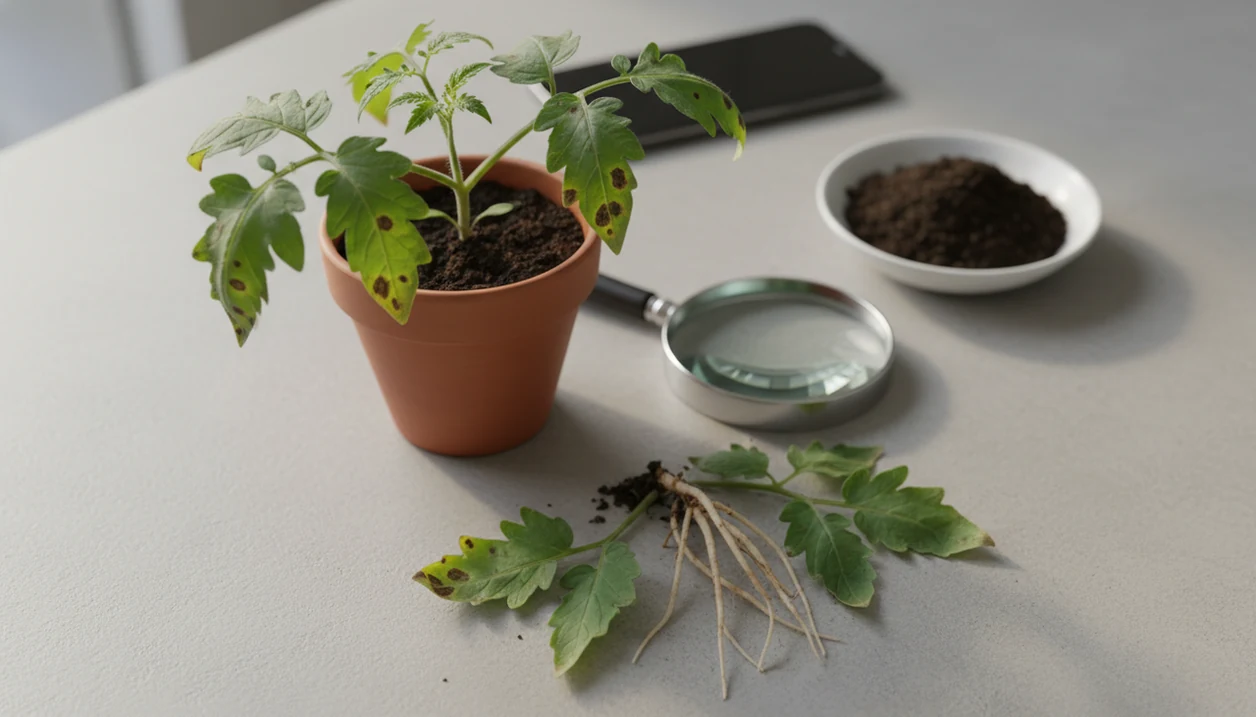
Plant disease diagnosis accuracy is strongest when an app analyzes clear, well-lit photos of visible leaf symptoms, but it becomes less reliable with blurry images, early disease, root problems, mixed infections, or lookalike stress symptoms. Treat AI results as a practical screening shortlist, not a laboratory-confirmed diagnosis.
> Definition: Plant disease diagnosis accuracy means how often a visual tool, expert, or lab method correctly identifies the real cause of plant symptoms.
TL;DR
- AI plant disease tools can exceed 90% accuracy in controlled studies, but real-world phone photos are harder than curated datasets.
- Photo-only diagnosis is weakest for root rots, vascular wilts, viruses, nutrient problems, watering stress, and mixed infections.
- Use app results to narrow possibilities, improve care decisions, and decide when to contact an extension service, plant pathologist, or diagnostic lab.
Plant Disease Diagnosis Accuracy At A Glance
AI can be useful for plant disease screening, but it should not be treated as definitive proof of the cause. Controlled studies often report high accuracy because the images are cleaner than the photos people take at home.
A benchmark leaf image may show one disease on one crop, centered in good light. A real phone photo may show glare, dust, old damage, pests, and a half-visible stem. We see this often with white powder on squash leaves, where the likely match may be powdery mildew, but spray residue or natural leaf markings can confuse the result.
Visual diagnosis is a care step, not a cure.
Use AI to narrow the shortlist, compare the leaf shape, stem, and growth habit, and decide what to do next. Ask an extension service, diagnostic clinic, or plant pathologist when symptoms spread fast, the plant is valuable, or treatment depends on a specific pathogen.
Five Facts About AI Plant Disease Accuracy
- Deep learning plant disease models often exceed 90% accuracy on benchmark datasets in review papers, but those results depend heavily on curated image conditions source.
- A 2024 Android app study reported about 94% classification accuracy under controlled leaf-photo conditions source.
- PlantVillage-style controlled image datasets have produced reported classification accuracies near 99% in some experiments, showing what models can do with clean, labeled leaf images source.
- Field photos usually reduce AI plant disease accuracy because lighting, angle, background clutter, symptom age, and plant condition change the input.
- Even trained agronomists can struggle to separate visually similar diseases at early stages, especially when symptoms overlap.
One blurred seedling photo in morning sun can look more like a color wash than a plant health clue. That matters. For home users, the safer question is not “is the score high?” but “do the photo clues, plant history, and spread pattern agree?”
How Plant Disease Diagnosis Works In Photo-Based AI
Photo-based AI plant disease diagnosis works by comparing visible symptom patterns in a user photo with patterns learned from labeled training images. It estimates a likely class; it does not directly prove that a fungus, bacterium, virus, or nutrient issue is present.
The usual pipeline is simple: photo input, feature detection, model classification, and a confidence score. In technical terms, the model turns image areas into image embeddings, which are numerical patterns it can compare. In plain terms, it looks for visual similarities.
Context still matters. A yellow patch on an older pothos leaf means something different from a yellow patch on a tomato seedling after a cold night. Recent watering, leaf location, spread speed, and species all change the shortlist. An app cannot see microscopic spores or internal tissue unless it is paired with lab tests, sensors, or human inspection.
Why Benchmark Plant Disease Accuracy Overstates Real App Results
Benchmark accuracy often overstates real app performance because curated datasets are easier than everyday plant photos. A 95% study result should not be read as a guarantee for every balcony pot, office plant, or backyard tomato.
| Situation | Why it is easier or harder | What it means for accuracy |
|---|---|---|
| Curated benchmark dataset | Clean leaves, known labels, fewer backgrounds | Scores can look very high |
| Real smartphone photo | Shadows, blur, mixed symptoms, odd angles | Accuracy often drops |
| Common crop disease | More examples may exist in training data | Results are usually more useful |
| Rare houseplant or ornamental | Fewer training examples and regional differences | Confidence may be misleading |
| Mixed infection or stress | Several causes create similar symptoms | Photo-only diagnosis may fail |
Researchers call this domain shift. The model learned from one image world, then receives another. A plant stand crowded by a balcony door also adds clutter, overlapping leaves, and uneven light. A careful plant health app should return a shortlist, explain the visible clues, and suggest next steps instead of promising a guaranteed diagnosis from one photo.
Plant Health App Limits For Symptoms Photos Cannot Prove
Photo diagnosis can suggest possibilities, but it cannot confirm every cause of plant decline. Yellowing, spotting, curling, wilting, and brown edges are shared by many diseases and non-disease stresses.
Diseases Poorly Suited To Photo-Only Diagnosis
Root rot: Leaves may wilt or yellow, but the key evidence is often below the soil line. You may need to slide the root ball out and check for dark, mushy roots.
Vascular wilt: Internal stem browning can be hidden until a cut stem or lab test confirms the pattern.
Viruses and bacterial infections: Some produce visible mottling or lesions, but confirmation may require ELISA, PCR, culture, or microscopy.
Stress Symptoms That Mimic Disease
Water stress: Overwatering and underwatering can both cause drooping leaves. Soggy potting mix smell is a clue a photo misses.
Nutrient issues: Deficiencies can mimic fungal or viral patterns, especially on older leaves.
Heat, herbicide, and light injury: These can create spots, scorch, curling, and distorted growth without an infectious disease.
For yellowing problems, a focused guide to diagnose yellow leaves is often more useful than treating every pale leaf as disease.
Common Myths About AI Plant Disease Accuracy
Myth 1: High confidence means correct. A confidence score reflects the model output, not verified truth. If the plant history conflicts with the result, slow down.
Myth 2: One leaf photo can diagnose any disease. One pretty leaf may hide the stem, soil surface, new growth, and lower leaves. Those missing clues often matter more than the leaf itself.
Myth 3: Accurate plant ID means accurate disease ID. Naming a monstera or basil plant is not the same task as separating fungal disease from watering stress.
Myth 4: Visual diagnosis is enough before pesticide use. Pesticides, heavy pruning, and plant disposal deserve stronger evidence.
Do this instead: take a second photo in natural light, include healthy and damaged areas, check the species, and compare the result with a regional source. For spotting patterns, our plant leaf spots diagnosis guide breaks down common lookalikes.
When To Trust AI Plant Disease Results
When should you trust AI plant disease results? Trust them more when photos are sharp, close, naturally lit, and show several affected areas, not just one damaged leaf.
The result is also more useful when the plant species is common and the symptoms are distinctive. Powdery white growth, rust-colored pustules, or a familiar pest pattern are usually better photo candidates than vague yellowing. For low-risk care steps, AI can help you isolate the plant, prune damaged leaves, improve airflow, or adjust watering.
Tools like PlantApp identify plants from photos and give care, watering, and disease troubleshooting steps, but the app result should still be used as a starting point. Trust less when confidence is high but the history does not fit. A plant that wilted right after repotting may have root damage, not the leaf disease named in the scan.
For low-risk plant care decisions, AI screening is often more useful than guessing because it forces you to compare symptoms against a short list.
When Plant Disease Diagnosis Needs Expert Or Lab Confirmation
Use expert or lab confirmation when the stakes are high, the symptoms are spreading, or the diagnosis will change treatment. Extension services, diagnostic clinics, plant pathologists, and labs can use culture, PCR, ELISA, microscopy, or sample inspection. University extension plant diagnostic clinics commonly ask for plant species, symptom history, site conditions, and representative samples because visual symptoms alone are often insufficient source.
- Escalate fast-spreading symptoms when several plants decline within days or a garden bed shows the same pattern.
- Protect valuable plants by confirming the cause before removing, isolating, or applying expensive treatment.
- Pause before pesticides when the app suggests fungal, bacterial, viral, or pest causes that need different controls.
- Request help for hidden problems such as root rots, vascular wilts, suspected viruses, bacterial diseases, and repeated failures.
- Provide useful context by sharing plant species, location, recent watering, fertilizer, weather, photos of healthy and damaged tissue, and how symptoms spread.
Plant pathologists generally recommend combining visual symptoms with plant history, local disease pressure, and laboratory testing when a specific pathogen must be confirmed.
Limitations
Plant health app limits matter because the wrong diagnosis can waste time, harm the plant, or lead to unnecessary chemical use. Lab testing remains the gold standard when a specific pathogen must be confirmed.
- Blurry, dark, backlit, distant, or heavily cropped photos reduce plant disease diagnosis accuracy.
- Apps cannot see roots, internal stems, vascular tissue, or microscopic pathogens in ordinary photos.
- Pests, nutrient problems, water stress, heat, herbicide exposure, and disease can produce overlapping symptoms.
- Training datasets may underrepresent houseplants, ornamentals, rare species, and regional pathogens.
- Confidence scores are not the same as verified correctness.
- Many consumer apps do not disclose field validation, training data sources, or diagnostic scope.
- Mixed infections can produce confusing symptoms that look like one disease in a photo.
- Early-stage disease can be visually subtle, even for trained professionals.
- Lab methods such as PCR, culture, microscopy, and ELISA are needed when confirmation matters.
The pot may look fine from above. Roots tell another story.
FAQ
How accurate are plant disease apps?
Plant disease apps can be highly accurate in controlled studies, sometimes above 90%, but accuracy varies widely with real phone photos. Treat results as screening suggestions, not verified diagnosis.
Can AI diagnose plant disease?
AI can suggest likely causes from visible symptoms, plant species, and photo patterns. It cannot confirm every pathogen without lab testing or expert inspection.
Why are app diagnoses wrong?
App diagnoses are often wrong because photos are blurry, symptoms overlap, the plant is uncommon, or the training data is limited. Early disease and mixed stress problems are especially difficult.
Are confidence scores reliable?
Confidence scores show how strongly the model favored one result over alternatives. They do not prove the result is biologically correct.
Can photos detect root rot?
Photos of leaves may suggest root rot when wilting or yellowing fits the history. The roots usually need inspection, and serious cases may need testing.
Can one photo diagnose disease?
One photo is rarely enough for reliable plant disease diagnosis. Multiple clear photos plus watering, light, soil, and spread history improve the result.
When should I use a lab?
Use a lab when symptoms are severe, spreading, expensive to treat, or likely to affect valuable plants. Suspected viruses, bacterial diseases, vascular wilts, and root rots often need confirmation.
Do experts misdiagnose plant diseases?
Yes, experts can misdiagnose visually similar plant diseases, especially at early stages. That is why plant history, regional context, and lab methods matter.
Is AI better than gardeners?
AI is fast at pattern recognition across many images. Gardeners often add better context, and experts or labs are needed when proof matters.