Plant Leaf Spots Diagnosis For Disease, Pests, And Stress
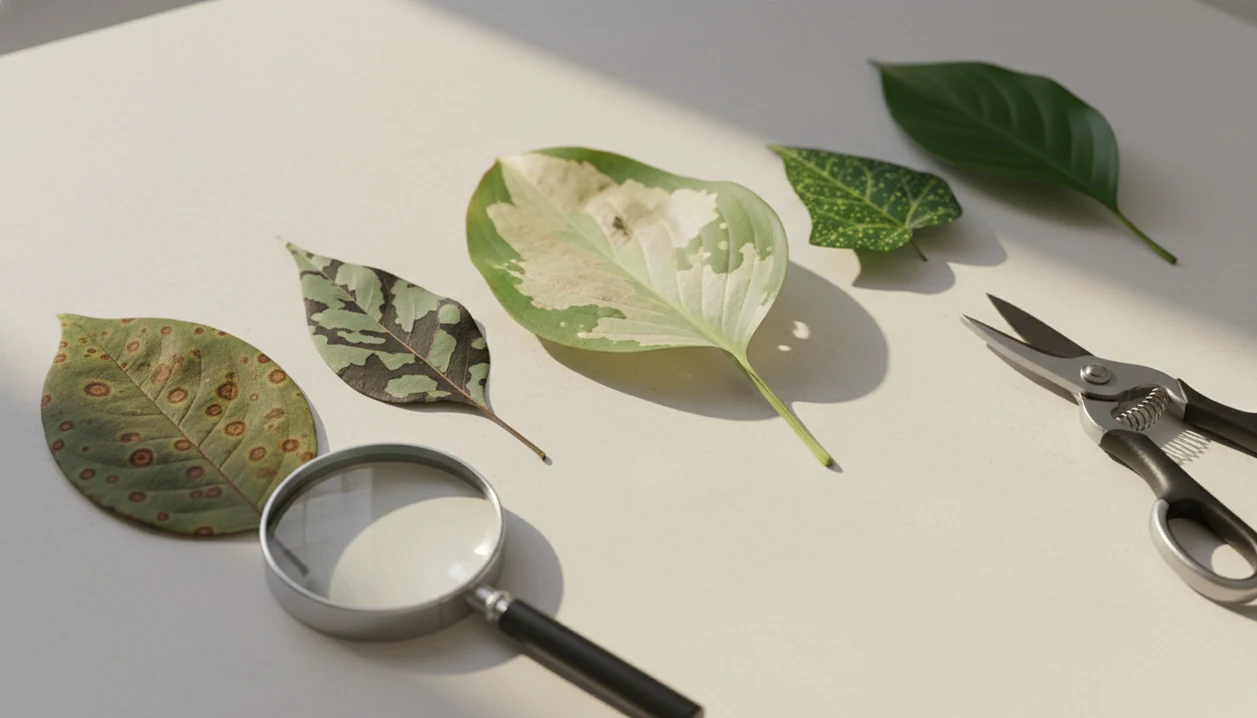
Plant leaf spots diagnosis starts by comparing spot shape, color, pattern, spread, and recent care changes before treating. Many spots on plant leaves come from disease, pests, sunburn, water marks, chemical injury, or nutrient stress, so the first decision is whether to isolate the plant, monitor it, or get expert help.
Definition: Plant leaf spots diagnosis is the process of identifying the likely cause of spots on plant leaves by combining visual clues, plant history, growing conditions, and symptom spread.
TL;DR
- Round spots with rings or black dots often suggest fungal leaf spot disease, while angular spots boxed in by veins more often suggest bacterial leaf spot.
- Spots that appear suddenly after sun exposure, spraying, fertilizing, repotting, or watering changes may be environmental stress rather than infection.
- Isolate fast-spreading, wet-looking, or multi-plant symptoms; monitor older, stable, dry spots on otherwise healthy plants.
Plant Leaf Spots Diagnosis Clues At A Glance
Plant leaf spots diagnosis works best when you read several clues together: color, shape, edge, texture, pattern, and spread. A brown circle, a bleached patch, and a wet-looking angular mark can point in very different directions.
Not every mark is leaf spot disease. Some spots are old sun damage, hard-water residue, fertilizer splash, mite feeding, or stress from soggy roots. We often see users photograph one pretty leaf, then miss the stem, potting mix, and lower leaves that would change the likely match.
Start with the next-step decision. Isolate a plant if spots are spreading fast, wet-looking, or appearing on nearby plants. Monitor if the marks are dry, old, and limited. Get expert help for valuable plants, repeated defoliation, or unclear symptoms. Tools like PlantApp can support photo-based sorting, but the app result should be a starting point, not a guaranteed diagnosis from one image.
Five Facts About Spots On Plant Leaves
- Leaf spots can come from fungi, bacteria, viruses, pests, sunburn, chemical injury, water stress, or nutrient problems. The same brown mark can have several possible causes.
- Fungal leaf spot disease often forms round lesions that may cross veins. Some spots show target-like rings or tiny black fruiting bodies in the dead tissue.
- Bacterial spots are often angular because leaf veins block their spread. They may look water-soaked at first, then turn brown or black with yellow halos.
- Many leaf spot diseases are mostly cosmetic on established trees, shrubs, and sturdy houseplants unless defoliation is heavy or repeated over seasons.
- Wet leaves, poor airflow, crowding, and overhead watering raise disease risk. University of Minnesota Extension gives the same prevention pattern for many leaf spot diseases: reduce leaf wetness, improve air circulation, and remove infected debris source. A watering can dripping on a saucer is less concerning than foliage staying wet overnight.
For houseplants, careful watering and clean airflow are usually a care step, not a cure. They lower pressure while you confirm the cause.
How Plant Leaf Spots Diagnosis Works
Plant leaf spots diagnosis is pattern matching plus context, not single-photo certainty. Visual symptoms are compared with plant history, recent care changes, and symptom distribution across old leaves, new leaves, one plant, or several plants.
The first split is infectious versus abiotic. Infectious causes include fungi, bacteria, and viruses. Abiotic causes are non-living stresses such as sunburn, fertilizer burn, spray damage, cold injury, hard-water spotting, or root stress. A macro shot of striped leaf veins can show lesion shape, but it won’t tell you whether the plant sat in a hot window yesterday.
Fungal causes are common, but not automatic. NC State Extension estimates that about 85% of plant diseases are caused by fungi, which explains why fungal leaf spots appear often in diagnosis guides source. Still, brown spots after a sudden outdoor move may be sun stress, not fungus.
A photo tool can suggest likely causes and care checks, but it cannot see last week's watering, spray use, pest history, or light change unless you record those details.
Before You Start Diagnosing Leaf Spots
Before you judge leaf spots, set up the plant and your notes so the clues are not distorted. Good light, clean handling, and recent care history can change the likely answer before you ever compare spot shape.
- Use natural light near a window or outdoors in open shade, and turn off the flash. Flash and warm bulbs can make yellow halos, tan centers, or black specks look more dramatic than they are.
- Inspect the whole plant before zooming in. Look under leaves, along stems, across the soil surface, and at the pot’s drainage holes for pests, mold, soggy mix, or blocked drainage.
- Put on gloves if debris is moldy, chemically treated, sticky, or unfamiliar. This keeps residue off your hands and reduces the chance of carrying material to another plant.
- Gather recent care details such as watering, fertilizer, sprays, repotting, outdoor moves, and light changes. A note from last weekend may explain today’s spots.
- Separate suspicious plants while you check them, especially before touching healthy plants nearby. Temporary distance buys time without assuming the problem is contagious.
How To Use A Leaf Spot Disease Photo Checklist
A leaf spot disease photo checklist helps you collect the evidence an app, extension office, or plant specialist needs. Better photos reduce guesswork, especially when fungal, bacterial, pest, and chemical injuries overlap.
- Photograph the whole plant in natural light so leaf pattern, growth habit, pot size, and overall decline are visible.
- Capture affected leaves from the top and underside, including the leaf stem and nearby healthy tissue.
- Take a close-up of lesions that shows borders, halos, rings, black dots, webbing, or papery texture.
- Record recent care changes including watering, light, humidity, sprays, fertilizer, repotting, and outdoor moves.
- Compare old and new growth so you know whether spots are still forming or only remain on older leaves.
Yellow kitchen light at 10 p.m. makes tan tissue look orange and black dots look muddy. Take a second photo in natural light before you decide. If you want a phone workflow, the full process is covered in how to diagnose plant disease with phone.
Step 1: Compare Leaf Spot Color, Shape, And Borders
“What do the color, shape, and border of leaf spots mean?” They narrow the likely cause, but one feature alone rarely proves it.
Brown or tan spots often mean dead tissue, whether from disease, sunburn, dryness, or chemical injury. Black spots can suggest fungal structures, bacterial damage, pest waste, or old necrosis. Yellow halos may appear around bacterial or fungal lesions, while red or purple spots can occur on some ornamentals under disease or stress. Bleached patches usually point toward sunscald or spray burn, especially after a light change.
Shape matters. Round spots that cross veins are more often fungal. Angular spots boxed in by veins are more suspicious for bacterial leaf spot. Borders add another layer: sharp margins, water-soaked edges, dry papery centers, scorched rims, or fuzzy growth all change the read.
A back porch shrub after rain may show wet, spreading lesions one day and dry cosmetic scars a week later. Timing matters.
Step 2: Separate Fungal Leaf Spot Disease From Bacterial Spots
Fungal leaf spot disease and bacterial leaf spot can look similar, but their patterns often differ. Use the table as a sorting guide, not as final pathogen identification.
| Clue | More typical of fungal leaf spot | More typical of bacterial leaf spot |
|---|---|---|
| Spot shape | Round or oval lesions | Angular, vein-bounded patches |
| Pattern | May cross leaf veins | Often stopped by leaf veins |
| Surface details | Concentric rings or tiny black spore dots | Wet-looking tissue, especially early |
| Color changes | Tan, brown, gray, or black centers | Brown or black patches with yellow halos |
| Confirmation | Microscopy or lab culture may identify fungus | Lab testing may be needed for exact bacterium |
Lab confirmation matters when the plant is valuable, symptoms repeat, or treatment choices carry cost or risk. For uncertain samples, university plant clinics treat photos as triage and recommend physical sample submission when exact pathogen confirmation is needed source. A rose leaf with rusty speckles, for example, should not be treated the same way as a pothos leaf burned by window glare.
When the ID is uncertain, compare the leaf shape, stem, and growth habit before choosing a product.
Step 3: Check Pests, Sunburn, Water Marks, And Nutrient Stress
Many spots on plant leaves are not leaf spot disease. These non-disease causes are easy to miss if you only zoom in on the damaged patch.
- Pest feeding: Spider mites create pale stippling and may leave tiny webbing under curled leaves. Thrips leave silvery scars and black frass. Scale can look like fixed brown bumps on stems or leaf veins. For close photo clues, use a guide to identify plant pests from photo.
- Sunburn: Bleached, crispy, or tan patches often appear after a plant moves from shade to direct sun. A winter shadow across an apartment floor can change light exposure more than people expect.
- Water and chemical marks: Hard water, overhead watering, leaf shine, soap sprays, and cleaning products can leave spots or burned edges.
- Nutrient and root stress: Yellowing, brown tips, and scattered necrotic marks may follow overwatering, compacted soil, circling roots, or fertilizer imbalance.
Root stress smells different. Soggy potting mix has a sour, stale note.
Step 4: Decide Whether To Isolate, Monitor, Or Get Expert Help
The safest next step depends on spread, severity, and uncertainty. Isolation is not always needed, but it buys time when symptoms look active or contagious.
| Decision | Use this when | What to do next |
|---|---|---|
| Isolate | Spots spread quickly, look wet, affect many leaves, or appear on nearby plants | Move the plant away, avoid overhead watering, remove badly affected debris, and recheck in a week |
| Monitor | Spots are old, dry, limited, and new growth looks clean | Mark affected leaves or photograph them, then compare changes over 7 to 14 days |
| Get expert help | Symptoms are severe, repeated, unclear, or on valuable plants | Contact an extension service, diagnostic lab, nursery specialist, or use a plant disease diagnosis app as a triage tool |
For beginners, monitoring with dated photos is often better than spraying immediately because it shows whether the problem is still active. Apps such as PlantNet and PictureThis can help organize photo clues, but uncertain cases still benefit from local extension offices, diagnostic labs, or nursery specialists.
Common Myths About Leaf Spot Disease Treatment
Leaf spot disease treatment works better when expectations are realistic. Several common myths lead people to over-prune, over-spray, or miss the actual trigger.
- Myth: every spot is contagious disease. Many marks come from sunburn, hard water, chemical splash, pests, or root stress.
- Myth: one photo always identifies the exact cause. A single blurry leaf photo can miss the underside, stem, and soil surface.
- Myth: fungicide heals spotted leaves. Fungicides may protect new growth in some situations, but dead tissue does not turn green again.
- Myth: clean new growth always means treatment is still needed. Clean new leaves can mean conditions changed and the issue has slowed.
Sanitation, airflow, careful watering, and removing fallen infected debris are often more useful than rushing to a spray. If the broader symptom is yellowing, it may help to diagnose yellow leaves before blaming leaf spot.
Verification Signs After Plant Leaf Spots Diagnosis
Verification means checking whether your response stopped new damage. Track new spots for 7 to 14 days, because old spots can remain after the active problem has passed.
Use dated photos. Same angle, same light.
New leaves emerging clean is a strong sign that stress has eased or infection pressure has dropped. Also check whether nearby plants develop matching spots. If they do, move faster on isolation, sanitation, and expert confirmation. If the old marks stay unchanged and new growth looks normal, the damage may be cosmetic.
Plant pests and diseases matter at crop scale, even though one spotted houseplant is usually not an emergency. The USDA has estimated that about 40% of U.S. crop losses are tied to plant pests and diseases, including foliar diseases source. That statistic should prompt careful diagnosis, not panic over one dry brown scar.
Cosmetic damage can remain visible for the life of that leaf.
Limitations
Visual diagnosis is useful, but it has real limits. Treat uncertain results with caution, especially before pruning heavily or applying pesticides.
- Different causes can look nearly identical in photos, especially fungal, bacterial, chemical, and sun damage.
- AI apps can misclassify damage when images are blurry, poorly lit, cropped too tightly, or missing care context.
- Some bacterial and viral diseases have no cure; management may mean isolation, sanitation, disposal, or expert confirmation.
- Home remedies have limited or inconsistent evidence and can burn leaves if mixed too strongly.
- Prevention reduces future spots but does not eliminate them, especially outdoors in wet weather.
- Fungicides and bactericides do not repair existing dead tissue.
- Lab testing may be needed for exact pathogen identification on valuable, edible, or landscape plants.
- Pet and child safety matters if leaves are removed and left where curious animals can reach them.
Tools like PlantApp can support likely-match sorting, but high-risk cases still need a regional source or diagnostic lab.
FAQ
What causes leaf spots?
Leaf spots can be caused by fungi, bacteria, viruses, pests, sunburn, chemical injury, water stress, nutrient problems, or root stress. Diagnosis starts by comparing visual clues with recent plant care changes.
Is leaf spot disease contagious?
Some fungal and bacterial leaf spot diseases can spread by splashing water, tools, hands, or nearby foliage. Spots from sunburn, fertilizer burn, hard water, or old stress are not contagious.
Should I remove spotted leaves?
Remove heavily spotted, dying, or fallen infected leaves, especially when disease is spreading. Leave a few stable cosmetic spots alone if the plant needs that foliage for growth.
Do brown spots mean fungus?
No, brown spots do not always mean fungus. Brown tissue can also come from sunburn, underwatering, overwatering, fertilizer burn, pests, cold damage, or chemical injury.
What do black dots mean?
Black dots may be fungal fruiting bodies, pest waste, scale insects, soil splash, or debris. Check whether the dots are embedded in the lesion, sitting on the surface, or moving.
Can leaf spots heal?
Dead spotted tissue usually does not turn green again. Recovery means new leaves emerge clean and existing spots stop expanding.
When should I isolate plants?
Isolate plants when spots spread quickly, look wet or soft, affect multiple leaves, or appear on several nearby plants. Isolation is also wise when the cause is unclear.
Can overwatering cause leaf spots?
Yes, overwatering can contribute to leaf spots by stressing roots and keeping foliage or soil too wet. Wet leaves, poor airflow, and soggy mix can also favor some leaf spot diseases.