Diagnose Brown Leaf Tips From Water, Light, Salts, Or Roots
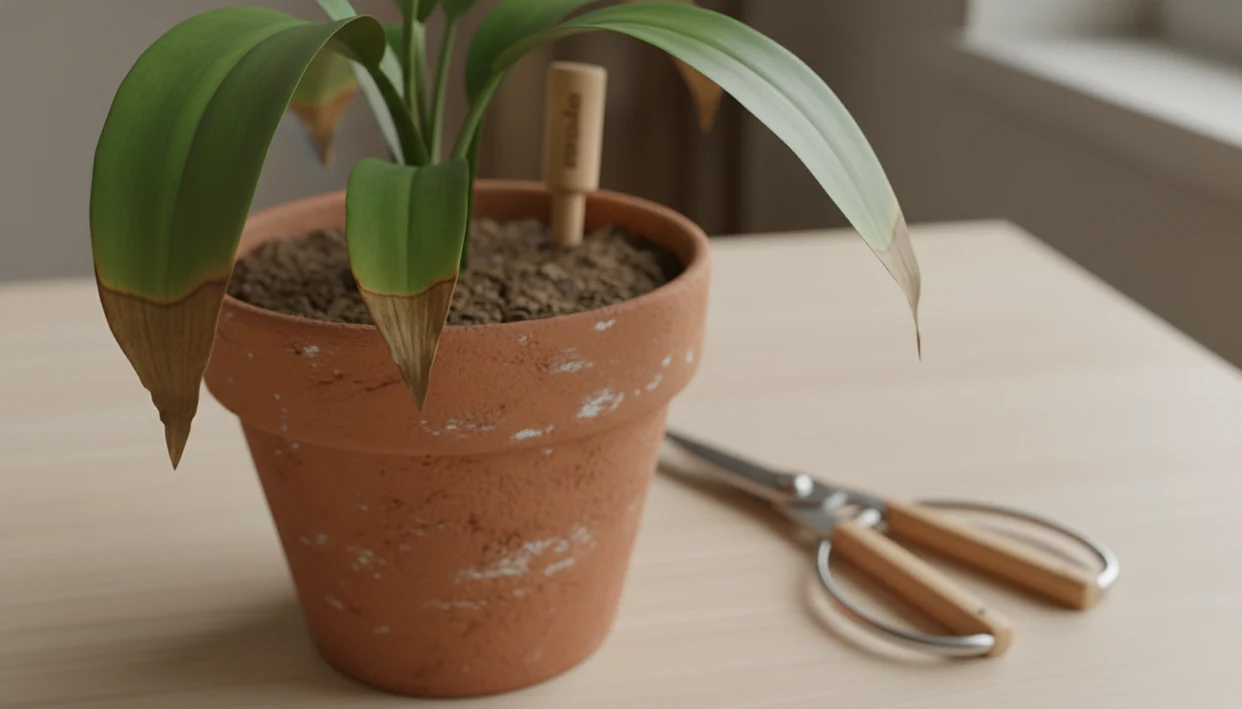
To diagnose brown leaf tips, check the soil moisture, root health, salt buildup, water quality, humidity, light exposure, and the plant species before cutting anything. Brown tips are dead tissue, but the pattern and root-zone clues usually reveal whether the cause is water stress, dry air, fertilizer salts, tap-water minerals, light stress, or root damage.
> Definition: Brown leaf tips are a plant stress symptom where the end of the leaf dries, browns, and dies because water, minerals, roots, or the growing environment are no longer supporting healthy leaf tissue.
- Brown tips on plants are usually a care or environment problem, not a disease by themselves.
- Start with the root zone: moisture, smell, drainage, root color, and salt crust tell you more than the leaf tip alone.
- Trim only the dead brown tissue after you adjust watering, humidity, fertilizer, light, or water quality.
Brown Leaf Tips At A Glance: Fast Cause Map
- Brown tips on plants are a symptom, not one disease; the same brown point can come from dry roots, soggy roots, salts, heat, or low humidity.
- Crispy tips with curled leaves often point toward dry air or dry soil, especially when the soil line is shrinking from the pot edge.
- Yellowing plus wet soil suggests root stress, while a sour or swampy smell means the pot needs a drainage check before more water.
- White crust on the soil or pot rim points toward fertilizer salts or mineral-heavy water; scorched patches on sun-facing leaves point more toward light or heat.
- Brown tissue will not turn green again, so the goal is to stop new tips from browning.
Tools like PlantApp can identify the likely species from photos and help log care causes, but root checks still matter. A plant photo alone cannot smell soggy mix.
How Brown Leaf Tips Work Inside Plant Leaves
Brown leaf tips usually form first because the leaf tip is at the far end of the plant’s water transport path. When water movement slows or cells are injured, the tip can dry and die before the rest of the leaf looks stressed.
Inside the plant, water moves through xylem, the tissue that carries water upward from roots. For a plant-science overview of xylem water movement and plant water transport, see the University of California Museum of Paleontology’s vascular plant overview source. Dry air, inconsistent watering, damaged roots, excess salts, and mineral toxicity can reduce that flow or pull water out of leaf cells. That is why tip burn can appear on an otherwise green leaf.
Abiotic stress means non-living causes such as water, light, temperature, salts, or chemicals. Infectious disease involves a pathogen, such as a fungus or bacterium. Most plant leaf tips brown from abiotic stress, but spreading spots, webbing, sticky residue, or collapse deserve a closer pest and disease check.
Before You Diagnose Brown Leaf Tips: Tools And Plant Clues
Start with a small inspection kit: your finger or a moisture meter, the saucer, drainage holes, light exposure, last watering date, last fertilizer date, and water source. The plant tag may be gone, or sun-faded to a pale blank strip, so identify the species before assuming one fix fits every pot.
Dracaena, spider plant, calatheas, palms, and peace lilies can react differently to minerals, dryness, and indoor air. A fuzzy purple stem or striped leaf margin can change the diagnosis. Take photos of the full plant, leaf tips, soil surface, and pot setup for comparison.
Pause fertilizer while you inspect. Avoid repotting immediately unless roots are clearly rotten, circling tightly, or trapped in compacted mix. A good AI plant identifier, disease diagnosis, and personalized plant care app for houseplants and garden plants gives likely matches and next care steps, not a guaranteed diagnosis from one photo.
How To Diagnose Brown Leaf Tips Step By Step
Diagnose brown leaf tips by starting below the leaf, then matching the damage pattern to the plant’s care history. The goal is not to find a perfect label in one minute, but to narrow the likely stress before you change anything.
- Check the root zone first by feeling the soil, looking through drainage holes, emptying any saucer water, and noticing whether the pot smells fresh, sour, or swampy.
- Compare the leaf pattern with the setup: dry, curled tips suggest dryness or low humidity; yellowing with wet mix suggests root stress; bleached patches point more toward light or heat.
- Look for salt clues such as white crust on the soil or pot rim, recent fertilizer, or several plants showing similar tip burn after using the same tap water.
- Identify the species before applying generic fixes, because a Dracaena, palm, calathea, spider plant, and succulent do not want the same humidity or water-quality response.
- Change only one or two conditions at a time, then judge the next several weeks of new growth instead of expecting old brown tips to recover.
Step 1: Check Soil Moisture And Roots For Brown Tips On Plants
“Are brown tips from overwatering or underwatering?” The most reliable first answer comes from the root zone, not the leaf tip. Test whether the mix is dry, evenly moist, soggy, compacted, or hydrophobic, which means water runs around the root ball instead of soaking in.
Healthy roots are usually firm and pale, white, cream, or tan. Rotting roots are mushy, dark, smelly, or collapsing when rinsed gently in the sink. Dry roots cannot deliver enough water to the leaf tips. Soggy roots lose oxygen, then decay, which also blocks water movement.
Dry Soil Decision
If the soil is bone-dry, rehydrate gradually. Water in rounds, let the mix absorb moisture, then empty the saucer.
Wet Soil Decision
If the soil is wet and smelly, stop watering, improve drainage, and inspect roots. If yellowing is also spreading, compare it with our guide to diagnose yellow leaves.
Step 2: Match Brown Leaf Tip Patterns To Humidity And Watering
Low humidity often causes crispy brown tips and edges, especially on tropical houseplants with thin leaves. Per the EPA, heated homes in winter can fall to 10 to 20% relative humidity, below the 30 to 50% range often recommended for indoor comfort and many plants source.
Watering rhythm matters too. Many brown tips follow a cycle of bone-dry soil, panic soaking, then another long dry spell. Calatheas and peace lilies show this fast; tougher plants may hide it for weeks.
The safest fix is boring but useful. Water when that plant’s preferred top layer is dry, not on a rigid calendar. Use a pebble tray or humidifier, group compatible plants, and keep leaves away from heater blasts. Misting alone usually raises humidity too briefly to solve repeated tip burn.
New leaves tell the truth.
Step 3: Test Fertilizer Salts And Tap Water Behind Brown Leaf Tips
Fertilizer salts and tap-water minerals can burn leaf tips when they build up in container soil. Look for white crust on the soil, residue around the pot rim, tip burn after feeding, or the same problem appearing across several plants watered from the same tap.
Over 85% of the U.S. population receives hard water, according to the USGS, and dissolved minerals can accumulate in pots over time source. University extension guidance notes that soluble salt buildup and excess fertilizer can injure roots and cause leaf tip or margin burn source. Dracaena and Chlorophytum, or spider plant, are known for fluoride sensitivity. Iowa State University Extension specifically lists Dracaena and spider plant among houseplants prone to fluoride toxicity symptoms such as tip burn source.
| Clue | Likely issue | Safer response |
|---|---|---|
| White crust on soil | Soluble salt buildup | Flush only if drainage is strong |
| Tip burn after feeding | Fertilizer excess | Pause fertilizer for several weeks |
| Dracaena tips browning | Fluoride or salts | Try distilled, rain, or filtered water |
| Many plants affected | Water source pattern | Compare tap water with an alternate source |
Never flush a pot with poor drainage. That makes mud, not recovery.
Step 4: Compare Light Stress, Heat, And Species Traits
Brown tips are not always a watering problem. Sun scorch often forms bleached, tan, or brown patches on sun-facing leaf areas, while tip burn stays concentrated at the leaf ends and margins. A leaf touching cold windowpane can also brown where tissue was chilled or dehydrated.
Room placement matters. Heat vents, radiators, drafty windows, and hot glass all dry leaf tips faster than the pot dries. A north-facing sill with a pale pothos tells a different story than a palm sitting beside a radiator.
Some species commonly show imperfect tips indoors, including palms, calatheas, spider plants, Dracaena, and peace lilies. For sensitive species, a few small brown points may be normal in dry homes. Move plants gradually, not from dim light straight into direct sun. For mixed symptoms, a plant disease diagnosis app can help sort photo clues before you change every condition.
How To Use A Plant Care Log To Diagnose Brown Leaf Tips
A plant care log helps diagnose brown tips by connecting damage to dates, watering, fertilizer, humidity, and room changes. For recurring plant leaf tips brown at the same time each month, records are often clearer than memory.
- Set the species so your care target matches the plant, not generic houseplant advice.
- Log watering with the date, soil feel, saucer water, and whether the mix resisted moisture.
- Record fertilizer type, dose, and timing, especially if tip burn appears within one or two weeks.
- Track room conditions such as winter heat, a moved pot, or humidity near a bright window.
- Compare new leaves every two to four weeks, because old brown tips will not turn green.
- Review patterns before repotting, pruning heavily, or changing water sources again.
A photo-based care log is most useful here when you photograph the stem, pot, soil surface, drainage setup, and the damaged tips together. A single close-up leaf photo can miss the wet saucer, crusted rim, or cramped roots causing the problem.
For brown tips, a simple care log is often easier than guessing because the damage usually follows repeated conditions, not one dramatic event.
Common Myths About Brown Tips On Plants
Brown tips on plants attract quick fixes, but several common ones make diagnosis worse. Check the root zone and growing conditions before acting on a single visual clue.
Underwatering myth: Brown tips do not always mean the plant is thirsty. Soggy, oxygen-starved roots can create the same dry-looking tip because damaged roots cannot move water.
Trimming myth: Cutting brown tips improves appearance, not the cause. It is cosmetic unless watering, salts, humidity, light, or roots also improve.
Misting myth: Misting alone rarely changes room humidity for long. A humidifier, grouping plants, or a pebble tray usually gives steadier air around sensitive leaves.
Disease myth: Every brown tip is not contagious. Most cases are abiotic stress, though spreading spots or pests need inspection.
Fertilizer myth: More fertilizer will not repair dead tissue. If salts are part of the issue, extra feeding can make tip burn worse.
Safe First Actions After You Diagnose Brown Leaf Tips
Correct one or two likely causes at a time. If you change watering, light, fertilizer, soil, and pot size in one afternoon, you lose the trail and may create a second stress event.
Start with the lowest-risk actions. Normalize watering for the species, improve drainage, raise ambient humidity, pause fertilizer, and move the plant away from heat vents or harsh direct sun. Flush salts only in free-draining pots, and stop if water sits in the mix or saucer. If you also see specks, webbing, or sticky leaves, use a focused check to identify plant pests from photo.
Trim dead brown tissue with clean scissors. You can follow the leaf shape and leave a thin brown edge so you do not cut into green tissue. Then wait several weeks. Improvement shows on new leaves and stable tips, not on old brown areas healing.
Small changes. Then watch.
Limitations
Brown leaf tips are useful clues, but they cannot prove one exact cause every time. Treat the diagnosis as a ranked list, then confirm it with soil, roots, records, and new growth.
- Brown leaf tips can have multiple overlapping causes, such as low humidity plus fertilizer salts.
- Dead brown tissue cannot recover or turn green again, even after care improves.
- Photo diagnosis can confuse abiotic stress with early pest or disease damage.
- Water-quality changes may take weeks, and often only new leaves show the benefit.
- Some species naturally develop minor brown tips in normal homes, especially in winter.
- Root inspection is still essential even when an app or visual guide suggests a likely cause.
- Repotting can help damaged roots, but it can also stress a weak plant if done too soon.
- Brown tips with soft stems, spreading leaf spots, or insects need a broader sick-plant check, such as an app that tells if plant is sick.
FAQ
Why are leaf tips brown?
Leaf tips turn brown when water stress, dry air, fertilizer salts, root damage, light or heat stress, tap-water minerals, or species sensitivity injures the end of the leaf. The tip is often the first place to dry because it is farthest from the root water supply.
Do brown tips mean underwatering?
Underwatering is possible, but brown tips can also come from soggy roots, low humidity, salts, hard water, heat, or fluoride-sensitive species. Check soil moisture and root condition before adding more water.
Should I cut brown tips?
You can trim brown tips with clean scissors after you address the likely cause. Cutting improves appearance but does not fix watering, humidity, salt, light, or root problems.
Can brown tips turn green again?
No, dead brown leaf tissue cannot turn green again. Recovery is judged by new leaves staying healthier.
Does tap water cause brown tips?
Tap water can contribute to brown tips when it contains high minerals, salts, or fluoride-sensitive compounds for species such as Dracaena and spider plant. Filtered, distilled, or rainwater may help sensitive plants over several weeks.
Can fertilizer burn leaf tips?
Yes, excess fertilizer can leave soluble salts in the potting mix and cause leaf tip or margin burn. Pause fertilizer and flush only if the pot drains freely.
Are brown tips a disease?
Most brown tips are abiotic stress, not disease. Check for pests, spreading spots, soft stems, mold, or sticky residue if symptoms move beyond dry tips.
How long until tips stop browning?
It may take several weeks to know whether the fix worked. Watch new growth and newly forming tips rather than expecting old brown tissue to recover.