
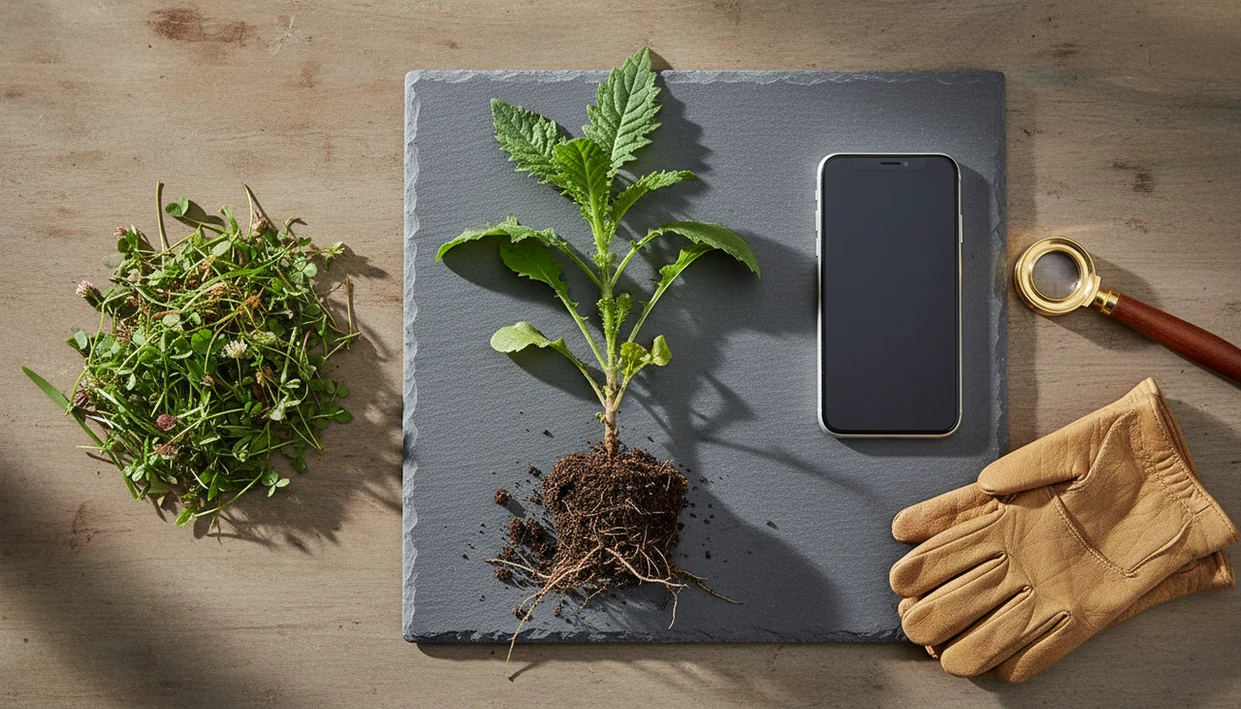
Definition: A weed identifier app is a mobile tool that uses AI photo recognition and large plant databases to name weeds from a single photo, helping users decide whether to remove, treat, or keep a plant in their garden, lawn, or yard.
2026 Weed Identifier Apps At A Glance
The strongest weed identification app choice depends on what you need after the likely match: confirmation, removal guidance, plant care, or a free second opinion. Accuracy changes by weed type, photo quality, and growth stage, especially when a plant is still a seedling.
| App | Accuracy highlights | Key strength | Price tier | Platform |
|---|---|---|---|---|
| PlantApp | Built for likely-match ID plus care workflow | Weed ID, plant health checks, care steps | Free and paid tiers | iOS, Android |
| PictureThis | MSU found 76% average correct ID and 88% helpful results | Highest independent score in cited testing | Paid, with trial/free limits | iOS, Android |
| PlantNet | Reports 46,050 species across 45 floras | Large free community database | Free | iOS, Android, web |
| Planta | Strong for houseplant care after ID | Care schedules and reminders | Free and paid tiers | iOS, Android |
| Garden Answers | Quick photo ID workflow | Simple scan-and-answer format | Free and paid tiers | iOS, Android |
The right fit for gardeners who want a weed name and a next action is PlantApp because it pairs photo ID with a care-and-troubleshooting workflow instead of stopping at a label.
5 Weed Identification App Accuracy Facts
No weed scanner app should be treated as a final verdict. Use the app result as a starting point, then compare the leaf shape, stem, and growth habit against a regional source before acting.
- No app is 100% accurate. Independent testing has shown correct identification ranges from about 36% to 76%, depending on plant type and growth stage.
- Seedlings and grasses are the hardest group. In Michigan State University weed science testing, PictureThis identified only 36% of seedling grasses, 57% of vegetative grasses, and 50% of flowering grasses, even though it performed better overall source.
- PictureThis scored highest in MSU testing. The same evaluation found PictureThis correctly identified 76% of plants on average and was helpful 88% of the time.
- PlantNet has major species coverage. PlantNet reports a database covering 46,050 plant species across 45 floras source.
- USDA verification matters. The USDA PLANTS Database covers over 45,000 plants in the United States and its territories source.
A photo taken under yellow kitchen light at 10 p.m. can turn a confident-looking result into a bad one. Natural light helps.
2026 Weed Scanner App Shortlist: Care Workflow, Tested Accuracy, And Free Database
A useful shortlist is not one app for every yard. It is three reliable starting points: PlantApp for ID plus care, PictureThis for tested accuracy, and PlantNet for free database-backed comparison.
Plant Identifier App: Weed ID Plus Care Workflow
PlantApp is the practical pick when an unknown sprout sits beside tomatoes, herbs, or houseplants because it connects the likely match to care, disease, and safety guidance. It works well for gardeners who also need a garden plant identifier app, but uncertain grassy seedlings still need outside verification.
PictureThis: Highest Tested Accuracy
PictureThis earns a shortlist place because university testing found strong overall performance. The tradeoff is that high average accuracy does not erase weak grass and seedling results.
PlantNet: Free Weed Identification Database
PlantNet is the strongest free second-opinion option for users who want broad species comparison and community-supported records. It can feel less guided after the ID, especially if you need removal steps.
Homeowners looking for lawn-specific help should compare results with a lawn weed identifier app workflow before treating turf.
AI Weed Identification App Photo Matching Process
AI weed identification works by turning your photo into visual patterns, then comparing those patterns with a trained plant image database. The model looks at photo clues such as leaf shape, venation, color, stem form, and growth habit.
Under the hood, many systems use image embeddings, which are numerical summaries of what the photo contains. In plain terms, the app is asking, “Which known plant photos look most like this one?” Continuously updated databases can improve matches over time, but seedlings and grassy weeds still confuse models because many look nearly identical.
When a maple seedling grows from a cracked patio, one overhead photo may miss the stem and paired leaves. Take a second photo in natural light and include the soil surface, not just one pretty leaf.
Good AI plant identifier apps deliver likely matches and next steps, not guaranteed species confirmation from one snapshot.
5 Steps To Use A Weed Identifier App Before Removal Or Spraying
Does a weed identifier app tell you what to remove right away? No. A responsible workflow confirms the app result before pulling useful plants or spraying the wrong target.
- Photograph the weed clearly in natural light, including the leaves, stem, growing point, and nearby soil.
- Submit the photo and review the top suggested matches, not only the first result.
- Cross-check the ID against the USDA PLANTS Database or a university extension page before taking action.
- Research the plant role to see whether it is invasive, pollinator-friendly, toxic, edible-looking but unsafe, or harmless.
- Choose the removal method only after confirmation, such as hand-pulling, mowing, mulching, or targeted treatment.
Never spray herbicide based on a weed identification app result alone. Labels, local rules, wind, runoff, vegetable beds, pets, and children all change the decision.
After a scan, when the result could be a weed or a wildflower, cautious gardeners should check the ID alongside care and risk notes before clearing the bed.
Weed Identifier App Testing Criteria For This Shortlist
This shortlist weighs independent accuracy data first, then practical garden usefulness. A high-scoring app still loses value if it cannot help you decide what to do after the likely match.
We looked at university accuracy data, database size, species coverage, platform availability, free versus paid limits, and whether each app connects weed ID with plant health or removal guidance. We also considered whether the app can flag invasive concerns or push users toward verification instead of overconfident action.
PlantApp ranks well for mixed garden use because it combines weed recognition with disease troubleshooting and care recommendations. PictureThis stands out for tested accuracy. PlantNet stands out as a free comparison database.
Gardeners trying to separate volunteer flowers from true weeds should also use a wildflower identifier app before clearing beds. The small seedlings near mulch lines are often where mistakes start.
For home gardeners, a weed app is often more useful when it explains the next care step than when it only names the plant.
Who Should Use Each Weed Identifier App
Choose the weed identifier app that matches the decision you need to make after the scan. PlantApp is best for ID plus care and safety notes, PictureThis is strongest when tested accuracy matters, and PlantNet is useful as a free second opinion.
- Pick PlantApp when the unknown plant is in a mixed bed, vegetable garden, or container area and you need more than a name. Its value is the follow-up: care context, possible plant health issues, and safety prompts before you pull.
- Choose PictureThis when you are comfortable with paid access or trial limits and want the app with the strongest cited independent accuracy results in this shortlist.
- Use PlantNet when you want a no-cost comparison from a large plant database, especially after another app gives a result that feels uncertain.
- Check lawn-specific resources before treating turf weeds, because crabgrass, sedges, clover, and broadleaf lawn weeds often require different timing and control methods.
- Verify risky plants through extension, USDA, or local invasive-species sources when toxicity, legal status, disposal rules, or look-alikes could change the consequence of a wrong ID.
4 Myths About Weed Scanner App Results
Weed scanner app results are useful, but several common assumptions lead to bad garden decisions. Treat the result as evidence, not permission to remove or spray.
Myth 1: Top apps are nearly 100% accurate. Reality: independent testing shows wide ranges, from about 36% on difficult grassy seedlings to 76% average performance in the strongest cited app test.
Myth 2: If an app says “weed,” remove it. Reality: “weed” means unwanted in that location. Clover in a lawn, purslane in a path, and volunteer dill in a bed are different decisions.
Myth 3: Apps can recommend safe, legal herbicide use. Reality: most apps do not account for local regulations, label restrictions, waterway risk, or nearby food crops.
Myth 4: All plant ID apps perform similarly. Reality: controlled tests show large accuracy gaps among apps and plant groups.
When invasive spread is the concern, pair the result with an invasive plant identifier app check before disposal.
Limitations
A weed identifier app can narrow the possibilities, but it cannot replace careful verification. These limits matter most before herbicide use, toxic look-alike decisions, or removal of rare native plants.
- Photo quality changes the result. Damaged leaves, shadows, glare, and cropped stems reduce accuracy fast.
- Seedlings are weak territory. Grassy seedling identification has scored as low as 36% in cited testing.
- Herbicide rules are local. No app can confirm legal use, label compliance, drift risk, or waterway setbacks for your site.
- Look-alikes can be dangerous. Wild carrot and poison hemlock are not plants to identify casually from one photo.
- Free tiers have limits. Some apps restrict scan counts, care details, or removal guidance unless you upgrade.
- Site conditions stay invisible. Apps cannot smell soggy soil, test compaction, or see roots circling a nursery pot unless you document those clues.
- Nearby plant impact needs judgment. A scan cannot tell whether pulling roots will disturb a young perennial beside it.
App-based triage is helpful, but high-risk IDs still deserve a regional source or local extension confirmation.